The discovery of huge amounts of water ice and possible organic compounds on the heat-blasted planet Mercury suggests that the raw materials necessary for life as we know it may be common throughout the solar system, researchers say.
Mercury likely harbors between 100 billion and 1 trillion metric tons of water ice in permanently shadowed areas near its poles, scientists analyzing data from NASA's Messenger spacecraft announced Thursday.
In the coldest parts of Mercury — permanently shadowed regions where temperatures drop to perhaps minus 370 degrees Fahrenheit (minus 223 degrees Celsius) — this ice can lie bare and exposed. But Messenger's data also show that much more frozen water is found in slightly warmer areas, buried beneath a strange dark material that acts as an insulator.
"This organic material may be the same type of organic material that ultimately gave rise to life on Earth," said Messenger participating scientist David Paige of UCLA.
Suddenly Mercury looks like a much easier place to visit and settle on than Mars. It's hot but it's also cold enough for ice which suggests there are quite liveable spots somewhere inbetween. There's ice, and so water, and lots of power in the form of solar energy. It sounds like there are other chemicals which could perhaps be put to use. It's much closer on average for communications. And being closer to the Sun it would be cheaper to get to because you're falling towards the Sun. Yes, that means it will be more expensive to come back but most of what you send won't be coming back.
From what I have read Mercury is assumed to consist of much of the same material as Earth's mantel. Is has the largest metallic core to surface ratio of any planet in the solar system, which seems to indicate it is an Earth like planet which lost most of its outer crust due to impacts, leaving behind an exposed rocky metallic planetoid.
NASA today announced a $1.5 billion plan to build another Mars rover based on the design of its current Curiosity rover, with the intention of sending it to the Red Planet in 2020 and perhaps storing up samples for later return to Earth.
Makes a lot of sense to re-use as much of the hardware as possible while developing new science cargo on the vehicle. Hopefully this time we get a little closer to testing for biology.
I'm keen to see what they have planned for this as it's not at all obvious. Curiosity has the ability to do chemical analysis. Except they've now discovered its limitations as the brief excitement over history making news has decisively ended. Seems yes, they found carbon. But they can't rule out the possibility that the small amount they found is terrestrial in origin. After all much of the Rover will be plastic and organic, and who knows whether flakes or residue from that could have made its way into the experiment. So they will need to get inventive with their science. More of the same won't be good enough, as all it will be doing is repeating what Curiosity's done, but ten years later.
If they want to send people there they should really get on with developing a lander which can take off again, with a few kg or Mars rocks in tow for return to Earth. Because they need to be able to do it with rocks before they do it with people, which with life support will be many times heavier and much more fragile. And arguably the science value of bringing rocks to Earth is more than the limited experiments Curiosity or its successor can do on Mars, at least based on what we know so far.
I think the terrestrial pollution risk is very low, they scooped and dropped four shovels of soil through the equipment before taking the actual measurement; effectively cleaning it with martian dirt before testing.
They aren't yet convinced that these carbon compounds aren't the result of contamination left over from the rover's time on Earth. And, if they are local, they're not sure what the chlorate compounds reacted with to produce what they see. It could potentially be something as simple as the CO2 being given off at the same time. Even if it's from the soil, there's no way of telling whether it was native to the soil or had arrived as Mars has been struck by material from comets and asteroids.
They just don't know for sure what they're measuring. It's very different from Earth where even a high school lab would find it easier to make sure samples were uncontaminated.
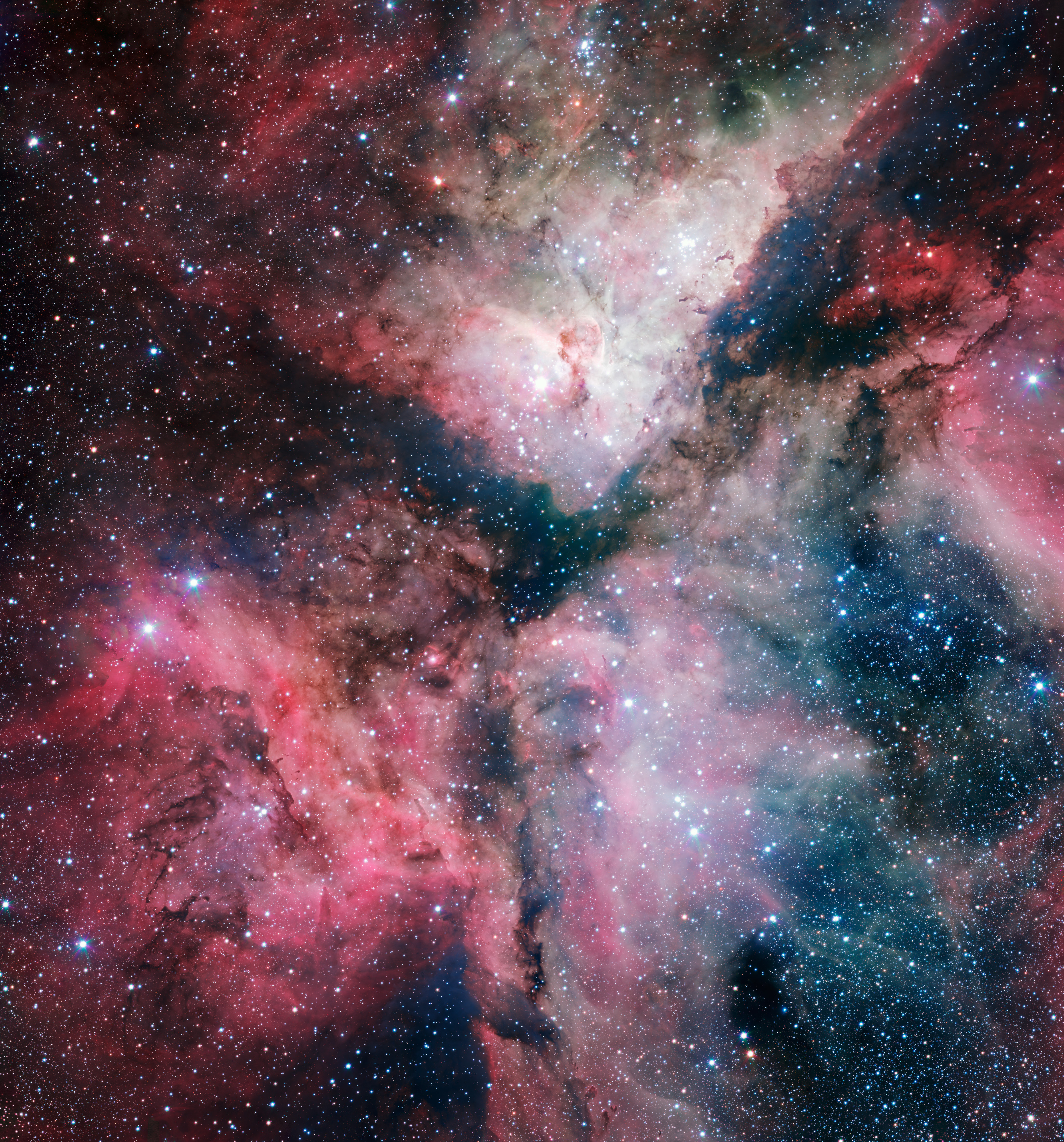
Interesting formations in the nebulae gas in the center bottom of the image, particularly how the flow of material is all in the same direction even though several light years separated.