http://www.nasa.gov/mission_pages/phoen ... 80616.html
Also, it seems sublimation is possible.


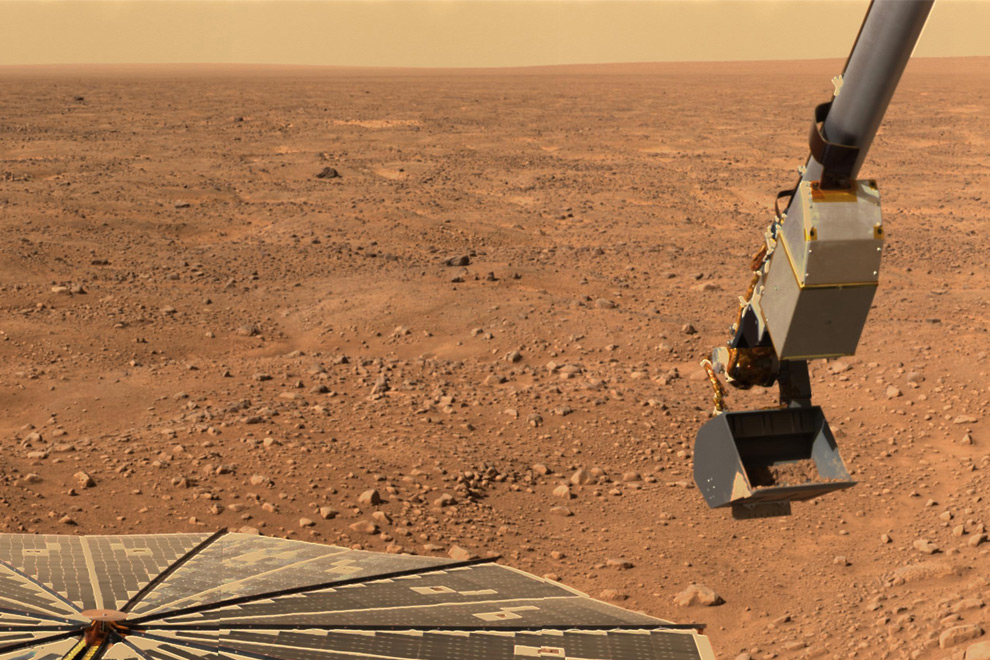
Could be chalk, if that's possible under that atmosphere.Darkflame wrote:More of the white stuff;
Some sublimation, sure. All of the water in a sample inside the lander, and thus in shade, I suspect not. We'll see.Also, it seems sublimation is possible.
Yeah, when you put it like that.Dio wrote:Chalk == sedimentary rock formed of the dead bodies of living creatures. That would be a surprise.
 I forgot that's what it is, I probably did know once upon a time.
It's one of the trio, potassium, calcium, sodium. They all burn on contact with water, and aren't that stable in air I think. The oxide might well be stable.Dio wrote:Like aluminium it tends to form a protective oxide layer. But it's a metal, so it wouldn't be white.
I have never seen granite with a colour anything like that, if those are real colours. Water ice is transparent, and very hard, it would need to be (compacted?) snow.Could be anorthosite or granite, perhaps... but water seems the most likely solution to me at this point.


Calcium is group II, with magnesium / strontium. It reacts well with acids, but poorly with liquid water. You're thinking of lithium or perhaps caesium?zip accident wrote:It's one of the trio, potassium, calcium, sodium. They all burn on contact with water, and aren't that stable in air I think. The oxide might well be stable.Dio wrote:Like aluminium it tends to form a protective oxide layer. But it's a metal, so it wouldn't be white.
If it's ice, it looks exactly like the sort you get inside a freezer, which instead of forming from liquid water freezing (i.e. large crystals), it forms by vapour in the air sticking onto an existing surface. Seems very plausible to me, since any ice formed is unlikely to have been formed directly from liquid water.I have never seen granite with a colour anything like that, if those are real colours. Water ice is transparent, and very hard, it would need to be (compacted?) snow.Could be anorthosite or granite, perhaps... but water seems the most likely solution to me at this point.
Lithium is one, but not that common. It's particular to lighter elements I think, so probably not Caesium so much, or maybe it's just that that is rarer. I thought I remembered people writing about calcium being one of the elements that were used in school demonstrations of igitibility in water.Dio wrote: Calcium is group II, with magnesium / strontium. It reacts well with acids, but poorly with liquid water. You're thinking of lithium or perhaps caesium?

Well, sort of, but more likely snow, I think. In my experience, freezer ice is still clear and very hard once you get through the outer snowy bits. That stuff is about the right colour for salt. There must be hundreds of white minerals it might be.If it's ice, it looks exactly like the sort you get inside a freezer, which instead of forming from liquid water freezing (i.e. large crystals), it forms by vapour in the air sticking onto an existing surface. Seems very plausible to me, since any ice formed is unlikely to have been formed directly from liquid water.

And the challenges of the repair workMost exciting are the new scientific instruments Atlantis’ spacewalkers will install. The Cosmic Origins Spectrograph....will observe the light put out by extremely faint, far-away quasars and see how that light changes as it passes through the intervening gas between distant galaxies. In this way scientists will learn what that gas is made of, how it’s changed over time and how it affects the galaxies around it.
And the new Wide Field Camera 3 will allow Hubble to take large-scale, extremely clear and detailed pictures over a very wide range of colors. At ultraviolet and infrared wavelengths the WFC3 represents a dramatic improvement in capability over all previous Hubble cameras. It is also a very capable visible light camera, though by design not quite as capable at visible wavelengths as Hubble’s Advanced Camera for Surveys. The WFC3 and ACS are designed to work together in a complementary fashion.
sourceThe new camera and spectrograph are designed to complement the scientific instruments already on the telescope – specifically the Advanced Camera for Surveys and the Space Telescope Imaging Spectrograph. But pieces of those instruments have failed in past years – not the entire instrument, but specific pieces inside of them. The crew will replace only the pieces that have failed.
But those instruments were never designed to be repaired in space. In fact, they were specifically designed not to come apart.
This basically puts to rest any concern that a Democrat President will cut back on NASA science, a common argument put forth by Republicans on space forums.In addition to directing NASA to fly AMS, the bill also endorses the basic outlines of President George W. Bush's 2004 call for the United States to complete the space station, retire the space shuttle and field a new system capable of carrying astronauts to the Moon, Mars and points beyond.
Rep. Bart Gordon (D-Tenn.), chairman of the House Science and Technology Subcommittee, hailed passage of the bill as a bipartisan endorsement of a robust U.S. space program.
"The bipartisan consensus we have reached on H.R. 6063 signals that Congress believes a balanced NASA program of science, aeronautics, and human spaceflight and exploration is important and worthy of the nation's support," Gordon said in a statement. "Yet, I want to emphasize that H.R. 6063 takes a fiscally-responsible approach to providing that support."