pfft, if you really want to be amazed, check out the comments.Orava wrote:http://www.physorg.com/news/2011-01-astronomers-mass-largest-black-hole.html
A humongous black hole has been discovered, event horizon the size of our solar system.
SPACE
-
Absolute_Zero

- Baaaaaa!

- Posts: 3564
- Joined: Wed May 18, 2005 4:11 pm 0
- Location: Hilbert Hotel, Heisenberg.
Re: SPACE

Re: SPACE
The idea is not to make it a source as such, but rather more like a catalyst for fussion;pogo wrote:The problem for using it as a source of energy is it's not exactly efficient. It takes a lot of energy to make lightning.
http://science.nasa.gov/science-news/sc ... 12apr99_1/While true antimatter and true fusion propulsion will remain the "rockets of the future" for some time, a hybrid of the two might work in the near term.
"It's a good short cut," Schmidt said of antimatter-catalyzed fusion. In this approach, a small quantity of antiprotons is beamed into a fusion target. The resulting matter-antimatter annihilation heats a target enough to cause thermonuclear fusion.
This was about rockets, but it seems like it might also work with power no?
-
want to read eye-wateringly bad stories? No? Ok.
want to read eye-wateringly bad stories? No? Ok.
-
teamonkey

- Sheepie Whore

- Posts: 12082
- Joined: Thu Jun 13, 2002 1:07 am 0
- XBL Gamertag: itsthetaste
- PSN: teamonkey_ca
- Contact:
Re: SPACE
I'm never really blown away by insightful comments on physorg. Like slashdot, it pays to have your comment filter set high.Absolute_Zero wrote:pfft, if you really want to be amazed, check out the comments.
-
Absolute_Zero
- Baaaaaa!
- Posts: 3564
- Joined: Wed May 18, 2005 4:11 pm 0
- Location: Hilbert Hotel, Heisenberg.
Re: SPACE
Question for anyone who'd like to show off their Phys/Math.Orava wrote:http://www.physorg.com/news/2011-01-astronomers-mass-largest-black-hole.html
A humongous black hole has been discovered, event horizon the size of our solar system.
With a Schwarzschild radius 4x Neptune, I'm guessing the gravitational gradient isn't going to be that uncomfortable within, right?
-
pogo

- Sheepie Whore
- Posts: 14180
- Joined: Tue Sep 10, 2002 8:28 pm 0
- Yahoo Messenger: BrassSparrow
- Location: County Durham
Re: SPACE
I would say that the gravity will for small objects seem linear, so you in theory wouldn't notice it the same way you would inside or near a small black hole: you wouldn't be ripped apart by the tidal forces, at least not immediately. But you'd still be sucked quickly towards the singularity at it's centre so very soon would suffer the fate of everything else pulled into a black hole.Absolute_Zero wrote:Question for anyone who'd like to show off their Phys/Math.Orava wrote:http://www.physorg.com/news/2011-01-astronomers-mass-largest-black-hole.html
A humongous black hole has been discovered, event horizon the size of our solar system.
With a Schwarzschild radius 4x Neptune, I'm guessing the gravitational gradient isn't going to be that uncomfortable within, right?
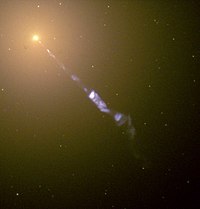
Except you might find that close to the even horizon things are very uncomfortable for other reasons: other masses being sucked into the black hole will be colliding, being compressed and otherwise smashed together generating energy which might make the space around the black hole very hot. Some of the matter being ejected is bright enough for us to see even 53 million light years away:
-
zip accident

- Sheepie Whore
- Posts: 13928
- Joined: Sun Feb 20, 2005 1:58 pm 0
- Location: Bristol, UK
Re: SPACE
That's not the biggest, it's the biggest accurately measured.Orava wrote:http://www.physorg.com/news/2011-01-astronomers-mass-largest-black-hole.html
A humongous black hole has been discovered, event horizon the size of our solar system.
The M87 black hole may not retain its title for long, since astronomers plan to continue looking for and calculating the sizes of many more black holes. One planned project involves connecting telescopes from around the world to observe the universe at wavelengths shorter than 1 millimeter. This set-up might enable the scientists to detect a silhouette of the M87 black hole’s event horizon. It might also enable them to calculate the size of another black hole with a roughly estimated mass of 18 billion solar masses, which is located in a galaxy about 3.5 billion light-years away.
The thing about really huge black holes is that the event horizon is about tangential velocity. The gravity at the event horizon is relatively small, because the radius is so large. So theoretically (ignoring the hot accretion disk, and the magnetic field, which might in reality be a problem), one could approach one of those things, and go in and out through the event horizon so long as you accelerated radially (light can't come out radially, so it's still an event horizon, but because it's so far from the pointmass the actual gravity at the EH is quite low). This idea is due to Larry Niven, or Gerry Pournelle, so it's not science fact as such, but I don't see how a black hole that diffuse can be different than described.pogo wrote:I would say that the gravity will for small objects seem linear, so you in theory wouldn't notice it the same way you would inside or near a small black hole: you wouldn't be ripped apart by the tidal forces, at least not immediately. But you'd still be sucked quickly towards the singularity at it's centre so very soon would suffer the fate of everything else pulled into a black hole.Absolute_Zero wrote:Question for anyone who'd like to show off their Phys/Math.
With a Schwarzschild radius 4x Neptune, I'm guessing the gravitational gradient isn't going to be that uncomfortable within, right?
Except you might find that close to the even horizon things are very uncomfortable for other reasons: other masses being sucked into the black hole will be colliding, being compressed and otherwise smashed together generating energy which might make the space around the black hole very hot. Some of the matter being ejected is bright enough for us to see even 53 million light years away:
"My way is the way of not fighting":- the book of Enter the Dragon.
-
teamonkey
- Sheepie Whore
- Posts: 12082
- Joined: Thu Jun 13, 2002 1:07 am 0
- XBL Gamertag: itsthetaste
- PSN: teamonkey_ca
- Contact:
Re: SPACE
It's not quite what you're asking, but first ask what size a neuron star with that mass would be. A neutron star has an average density of an atomic nucleus, 3x10^17kg.m-3 according to wiki.Absolute_Zero wrote:With a Schwarzschild radius 4x Neptune, I'm guessing the gravitational gradient isn't going to be that uncomfortable within, right?
The black hole is 6.6Mo = 1.31x10^40kg.
From that you get a spherical volume 4.37x10^22m3 and a radius of only 21850645.7m or just 0.03 solar radii! So even with a Schwartszhild radius bigger than the solar system you can have a very concentrated mass at the centre and the rest being empty space.
Let's just check that their Schwartzchild radius calculation is correct. The Schwartzchild radius is the distance from a body where the escape velocity is equal to the speed of light.
v^2 = c^2 = 2GM/r => r = 1.94x10^13 m = 27893.6 solar radii = 4.3x semi-major axis of Neptune.
-
pogo
- Sheepie Whore
- Posts: 14180
- Joined: Tue Sep 10, 2002 8:28 pm 0
- Yahoo Messenger: BrassSparrow
- Location: County Durham
Re: SPACE
No you couldn't. The 'event horizon' is so named as nothing escapes: no events are reported as it requires light or something else that travels at light speed or less to report them. You can think of it in terms of escape velocity: the velocity is so great that even light isn't fast enough. Mathematically though it can be far more precise: all paths from inside the even horizon are curved so much they go back inside the hole due to the curvature induced by general relativity. Everything travelling at light speed or less follows one of those paths. Travelling tangentially doesn't exempt you from the laws of physics, it just means you would fall to the centre sooner.zip accident wrote:The thing about really huge black holes is that the event horizon is about tangential velocity. The gravity at the event horizon is relatively small, because the radius is so large. So theoretically (ignoring the hot accretion disk, and the magnetic field, which might in reality be a problem), one could approach one of those things, and go in and out through the event horizon so long as you accelerated radially (light can't come out radially, so it's still an event horizon, but because it's so far from the pointmass the actual gravity at the EH is quite low). This idea is due to Larry Niven, or Gerry Pournelle, so it's not science fact as such, but I don't see how a black hole that diffuse can be different than described.
-
zip accident
- Sheepie Whore
- Posts: 13928
- Joined: Sun Feb 20, 2005 1:58 pm 0
- Location: Bristol, UK
Re: SPACE
I know what you mean, and I've heard that myself. It may be a confusion between the ergosphere and the event horizon.pogo wrote:No you couldn't. The 'event horizon' is so named as nothing escapes: no events are reported as it requires light or something else that travels at light speed or less to report them. You can think of it in terms of escape velocity: the velocity is so great that even light isn't fast enough. Mathematically though it can be far more precise: all paths from inside the even horizon are curved so much they go back inside the hole due to the curvature induced by general relativity. Everything travelling at light speed or less follows one of those paths. Travelling tangentially doesn't exempt you from the laws of physics, it just means you would fall to the centre sooner.
However, if you work out how dense the thing is (not the singularity, the volume enclosed by the event horizon), it's not that dense. When they get gigantic, black holes become even stranger. When you have a BH of this sort of mass (billions of suns, a (barely) significant fraction of the mass of the galaxy that contains it, the strength of the gravitational field at the EH is not that big. It doesn't fade away that quickly (really doesn't), but it's not that strong, it's comparable to the gravity at the surface of a planet, maybe less).
A thing is, light leaving it at a tangent, falls in. That means the radius of curvature of a light beam is the radius of the black hole's event horizon. For very small black holes, since light is so fast, that implies that the angular acceleration of the light is very high. For a BH with a EH with a circumference of a light year, the angular acceleration is (just over) 360 degrees per year, and that's not very much at all.
"My way is the way of not fighting":- the book of Enter the Dragon.
-
Absolute_Zero
- Baaaaaa!
- Posts: 3564
- Joined: Wed May 18, 2005 4:11 pm 0
- Location: Hilbert Hotel, Heisenberg.
Re: SPACE
It looks as though the 'kill' point is well inside the event horizon.
http://en.wikipedia.org/wiki/Spaghettification
specifically:
http://en.wikipedia.org/wiki/Spaghettif ... nt_horizon
http://en.wikipedia.org/wiki/Spaghettification
specifically:
http://en.wikipedia.org/wiki/Spaghettif ... nt_horizon
Re: SPACE
Cats in Zero gravity;
I'm not normally one for cat videos, but who can resist this one?
I'm not normally one for cat videos, but who can resist this one?
-
want to read eye-wateringly bad stories? No? Ok.
want to read eye-wateringly bad stories? No? Ok.


-
pogo
- Sheepie Whore
- Posts: 14180
- Joined: Tue Sep 10, 2002 8:28 pm 0
- Yahoo Messenger: BrassSparrow
- Location: County Durham
Re: SPACE
Laser powered flight:
http://www.economist.com/node/17951584
Very space related as it in theory solves the problem of rocket powered flight: almost all of the mass of a rocket is fuel so almost all the energy goes into lifting fuel into space. It mentions space elevators which I'm still not convinced about but this potentially solves the problem of powering such a system.
-
zip accident
- Sheepie Whore
- Posts: 13928
- Joined: Sun Feb 20, 2005 1:58 pm 0
- Location: Bristol, UK
Re: SPACE
However, space elevators are not a technology we have, and there's no way we know of of using electricity to propel a craft not attached to a rail or something similar.pogo wrote:Laser powered flight:
http://www.economist.com/node/17951584
Very space related as it in theory solves the problem of rocket powered flight: almost all of the mass of a rocket is fuel so almost all the energy goes into lifting fuel into space. It mentions space elevators which I'm still not convinced about but this potentially solves the problem of powering such a system.
It is interesting, but it's not going to replace rocket motors in the forseeable future.
"My way is the way of not fighting":- the book of Enter the Dragon.
Re: SPACE
I think you'd end up with a hybred system.
If you can get a space elevator to the ground (I still think a half-way one is infinitely more practical..), then you can power it up the cable from a base station at least some of the way. Transformers and such would be very lightweight compared to the thickness of the cable.
Once your on the cable, you can take as long as you want to climb up...you dont need to accelerate at any real speed, so maybe just solar power from cells on the crawler itself could work.
If, on the other hand, you use a half-way space elevator, you could use a counter balance and winch system which might have stored its energy months in advance via solar stored which was stored in potential energy by moving a large mass to different orbits.
The scales of rope here are ridiculous in both scenarios, of course, but I don't think energy delivery will be much of a problem relatively speaking.
I think lazer-power is possible more useful for drones and ultra-light aircraft here on earth.
http://en.wikipedia.org/wiki/Tether_pro ... ic_tethers
If you can get a space elevator to the ground (I still think a half-way one is infinitely more practical..), then you can power it up the cable from a base station at least some of the way. Transformers and such would be very lightweight compared to the thickness of the cable.
Once your on the cable, you can take as long as you want to climb up...you dont need to accelerate at any real speed, so maybe just solar power from cells on the crawler itself could work.
If, on the other hand, you use a half-way space elevator, you could use a counter balance and winch system which might have stored its energy months in advance via solar stored which was stored in potential energy by moving a large mass to different orbits.
The scales of rope here are ridiculous in both scenarios, of course, but I don't think energy delivery will be much of a problem relatively speaking.
I think lazer-power is possible more useful for drones and ultra-light aircraft here on earth.
Not of much use here, but its actually possible to move low satellites a bit via a charged cable;, and there's no way we know of of using electricity to propel a craft not attached to a rail or something similar.
http://en.wikipedia.org/wiki/Tether_pro ... ic_tethers
-
want to read eye-wateringly bad stories? No? Ok.
want to read eye-wateringly bad stories? No? Ok.