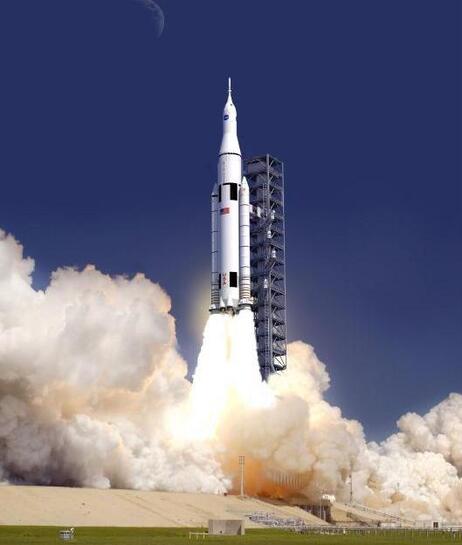
The heavy-lift version of the Space Shuttle replacement has a slightly new design, more Apollo less Shuttle external fuel tank-ish.
The new space launch system will be much bigger and far more powerful. It will be able, initially, to lift as much as [154,000] pounds of cargo into space, nearly three times as much as the space shuttle, which had a capacity for about 50,000 pounds.
This is enough to lift space capsules, astronauts and the supplies they will need for voyages to the moon and possibly beyond.
The announcement comes after weeks of wrangling between the U.S. Senate and NASA and the White House. In the end the Senate seems to have gotten what it wanted, an affordable heavy lift system ready to fly by 2017.
Saw a demo/proto version of that at a space conference / graduate recruiting event I went to once. The wheels make a hilarious clanking noise from the internal suspension as it moves around, nobody could quite keep a straight face...
It's very cool that control systems have developed to a point where we can do something that elaborate with a reasonable expectation of success. But why is it making audible noises outside the Martian atmosphere?
Stone wrote:It's very cool that control systems have developed to a point where we can do something that elaborate with a reasonable expectation of success. But why is it making audible noises outside the Martian atmosphere?
It is half-term. Just been to the Science Museum in London with the kids.
Never knew they had a Black Arrow, an authentic Apollo landing craft, a full size model of the lunar lander and a German V2 in there.
Altogether with the Apollo "4D" experience this has managed to entertain three kids from 4 to 10 years for hours, they all want to be astronauts at the moment. Free entry as well.
...and I for one welcome our giant hyper-intelligent radioactivity-loving mutant Tardigrade/Deinococcus-Radiodurans hybrid overlords.
This package of hardy micro-organisms will make the journeys out and back inside a separate compartment in the return capsule.
It will test theories on how living organisms could spread through the Solar System by simulating aspects of the long-duration voyage that microbes could make in a meteoroid that has been blasted off one planetary body and landed on another.
The microscopic participants in LIFE include the bacterium Deinococcus radiodurans, known for its ability to withstand high doses of radiation, and the eight-legged tardigrade (or "water bear"), a microscopic invertebrate that has already demonstrated its ability to survive short exposure to the space environment.
Yes, I wonder how they did the safety case for a splashdown...potentially contaminating the surface with organisms that we're confident would survive doesn't seem terribly bright. Tardigrades are basically indestructible!