

Inches per second, and back.zip accident wrote:A couple from me:
Millimeters per nano-second,
Lightseconds per year.
Any other interesting ones?
Unusual units of speed?
Re: Unusual units of speed?
Trippy vibes...
http://soundcloud.com/two-gapper
http://soundcloud.com/two-gapper
-
pogo

- Sheepie Whore

- Posts: 14180
- Joined: Tue Sep 10, 2002 8:28 pm 0
- Yahoo Messenger: BrassSparrow
- Location: County Durham
Re: Unusual units of speed?
You could for time use the age of the universe: much like c it's a limit so every time we can measure is a fraction of it, and even times in the future are at most small multiples of it. And over the times scales we're concerned with it's pretty constant. The problem is though we don't know it with any degree of accuracy. E.g. here it gives it accurate to about 1 part in 100, and describes it as the 'best current estimate' which probably means it can change significantly.
-
Stone

- Sheepie Whore
- Posts: 14497
- Joined: Thu Jun 26, 2003 6:49 pm 0
- XBL Gamertag: thestony1
- Location: Harpenden
Re: Unusual units of speed?
But that's how it's currently defined. (nearly, it's the distance light travels in a vacuum in 1 ⁄ 299,792,458 of a second)pogo wrote:If we had understood the universe better then we might have dispensed with the two definitions and just e.g. have defined the metre as 1 / 300,000 the distance travelled by light in a second.
In the same way, the speed of light in a vacuum is defined as exactly 299,792,458 metres per second, which shifts the problem of definition to the second. Luckily we can define time a lot more easily than distance, so we call it
and call it quits.the duration of 9,192,631,770 periods of the radiation corresponding to the transition between the two hyperfine levels of the ground state of the caesium 133 atom
So, what's the problem again?
Also I for one would be really happy if everybody used the qualifier 'in a vacuum' when they're talking about fundamental limits, because the incorrect usage is the single thing most likely to stop people from understanding Cherenkov radiation and refraction...
Stone
-
pogo
- Sheepie Whore
- Posts: 14180
- Joined: Tue Sep 10, 2002 8:28 pm 0
- Yahoo Messenger: BrassSparrow
- Location: County Durham
Re: Unusual units of speed?
I know, but that's only an accident of two definitions, that of the second and the metre. Very untidy too, within 0.1% of being a nice round number. The second has been set for a long, long time but the metre was only defined recently and initially only vaguely as a fraction of the Earth's circumference (a very problematic way to define it as the Earth is far from round). A little more than 100 years later Einstein's special relativity established that the speed of light was fixed and universal, and so the metre could be defined in terms of the second.Stone wrote:But that's how it's currently defined. (nearly, it's the distance light travels in a vacuum in 1 ⁄ 299,792,458 of a second)pogo wrote:If we had understood the universe better then we might have dispensed with the two definitions and just e.g. have defined the metre as 1 / 300,000 the distance travelled by light in a second.
-
Stone
- Sheepie Whore
- Posts: 14497
- Joined: Thu Jun 26, 2003 6:49 pm 0
- XBL Gamertag: thestony1
- Location: Harpenden
Re: Unusual units of speed?
No it didn't!pogo wrote:A little more than 100 years later Einstein's special relativity established that the speed of light was fixed and universal

I'm not just being petty, it is important...
-
pogo
- Sheepie Whore
- Posts: 14180
- Joined: Tue Sep 10, 2002 8:28 pm 0
- Yahoo Messenger: BrassSparrow
- Location: County Durham
Re: Unusual units of speed?
Like most people (or at least most with enough physics to understand it) I think that their result is down to a measurement error. It's not even been published, i.e. in a journal, which is usual before it's even looked at by other scientists who can then confirm or refute it, so it's far to early to say they've got anything that challenges relativity.
(the implications of travelling faster than light are pretty profound. For one thing anything travelling faster than light in our frame of reference goes backwards in time in another: for some observer it arrives before it sets out. That violates not only the laws of physics but also causality and common sense)
(the implications of travelling faster than light are pretty profound. For one thing anything travelling faster than light in our frame of reference goes backwards in time in another: for some observer it arrives before it sets out. That violates not only the laws of physics but also causality and common sense)

Re: Unusual units of speed?
I dont think so - as unlikely as it is for C to be bigger, the "limit" of C could still hold merely wiith a different value of C.
It doesnt violate logic in-itself to have a different value. (yes, you would observe clocks going backwards if you were on soimething going above light speed due to you going faster then the photons arriving at you, but that isnt the same as a true causality violation.).
It doesnt violate logic in-itself to have a different value. (yes, you would observe clocks going backwards if you were on soimething going above light speed due to you going faster then the photons arriving at you, but that isnt the same as a true causality violation.).
-
want to read eye-wateringly bad stories? No? Ok.
want to read eye-wateringly bad stories? No? Ok.


Re: Unusual units of speed?
Stone's not talking about the FTL neutrinos. He's talking about Cherenkov radiation - that's what his posted image is showing. The eerie blue glow of such radiation.
Light travels slower than c when passing through a medium, so it's perfectly possible to exceed the speed of light in a medium without exceeding the speed of light in a vacuum - a.k.a. "c" - as that's where your Cherenkov radiation appears.
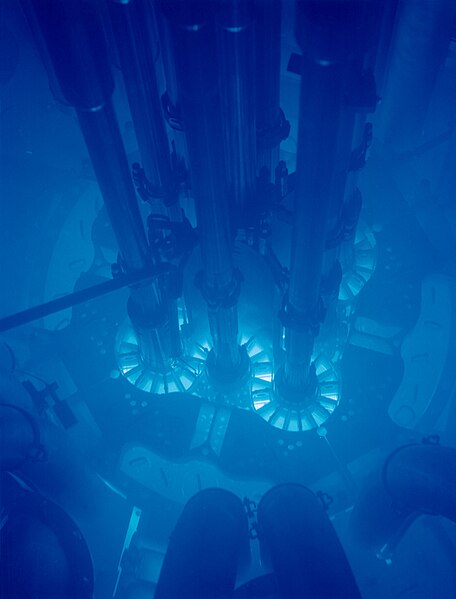
Which is why he's insisting on folks correctly suffixing the "in a vacuum" to "speed of light" when talking about c.Wikipedia wrote:Cherenkov radiation (also spelled Cerenkov or Čerenkov) is electromagnetic radiation emitted when a charged particle (such as an electron) passes through a dielectric medium at a speed greater than the phase velocity of light in that medium.
Light travels slower than c when passing through a medium, so it's perfectly possible to exceed the speed of light in a medium without exceeding the speed of light in a vacuum - a.k.a. "c" - as that's where your Cherenkov radiation appears.
"Words ought to be a little wild - for they are assaults of thought on the unthinking."
- John Maynard Keynes
- John Maynard Keynes
-
pogo
- Sheepie Whore
- Posts: 14180
- Joined: Tue Sep 10, 2002 8:28 pm 0
- Yahoo Messenger: BrassSparrow
- Location: County Durham
Re: Unusual units of speed?
Ah, then he is being petty. If you mention 'speed of light' without qualification, especially as a constant, it's c. I tend to use them interchangeably though in a forum such as this will usually start with speed of light.
-
Stone
- Sheepie Whore
- Posts: 14497
- Joined: Thu Jun 26, 2003 6:49 pm 0
- XBL Gamertag: thestony1
- Location: Harpenden
Re: Unusual units of speed?
I'm not - even some of the guys on my uni course after gods-know how many years of physics instruction still didn't realise that it's only constant in a vacuum, and it's entirely down to people either assuming everyone knows that bit or not making the distinction correctly. This is why light travelling down fibres doesn't travel at c, which still seems to evade everyone  It affects everything from optics to drift speeds in semiconductors to nuclear physics, and it particularly upsets me in relation to the neutrinos since none of the news coverage made any sense at all.
Don't get me started on how E=mc^2 is fixated upon with such intensity instead of, say, the Maxwell equations or Boyle's law...
Stone
It affects everything from optics to drift speeds in semiconductors to nuclear physics, and it particularly upsets me in relation to the neutrinos since none of the news coverage made any sense at all.Don't get me started on how E=mc^2 is fixated upon with such intensity instead of, say, the Maxwell equations or Boyle's law...
Stone
Re: Unusual units of speed?
Sorry, my mistake.
I shouldnt jump to conclusions.
I did read awhile back that we almost managed to stop light completely somehow. That did confuse me though, as I couldn't figure out what stopped light would be, nor how it would naturaly reaccelerate without addition energy put in it.
I shouldnt jump to conclusions.
I did read awhile back that we almost managed to stop light completely somehow. That did confuse me though, as I couldn't figure out what stopped light would be, nor how it would naturaly reaccelerate without addition energy put in it.
-
want to read eye-wateringly bad stories? No? Ok.
want to read eye-wateringly bad stories? No? Ok.
-
Stone
- Sheepie Whore
- Posts: 14497
- Joined: Thu Jun 26, 2003 6:49 pm 0
- XBL Gamertag: thestony1
- Location: Harpenden
Re: Unusual units of speed?
Really they're slowing the group velocity down - the photons travel at the expected speed (c / refractive index) but any variation in amplitude can travel faster or slower than the light does. Lots more info here.
Stone
Stone
Re: Unusual units of speed?
Even that confuses me thoughStone wrote:Really they're slowing the group velocity down - the photons travel at the expected speed (c / refractive index)

Its not light slowing down that gets me.....its the fact it speeds up again when it leaves the other medium. Surely that implies light has its own continuous propulsion

If it acted like a bullet - with all its energy given in one go when it was emitted - then traveling though a denser medium would slow it down - but it wouldn't regain its speed when it leaves. Where would the energy needed for that re-acceleration come from?
-
want to read eye-wateringly bad stories? No? Ok.
want to read eye-wateringly bad stories? No? Ok.
-
pogo
- Sheepie Whore
- Posts: 14180
- Joined: Tue Sep 10, 2002 8:28 pm 0
- Yahoo Messenger: BrassSparrow
- Location: County Durham
Re: Unusual units of speed?
The energy of a unit of light, a photon, depends on its frequency which doesn't change as it goes through a medium. So it loses no energy and has nothing to regain on exiting. Did you do experiments at school with water waves in a tray, slowing down then speeding up over a shallower area. The effect is similar: the speed and wavelength changes but not the frequency.
It goes that speed inside or outside the medium as that's the speed it goes at. One explanation is that it's because the speed of light is given by 1 / √εμ, where ε is the electrical permittivity and μ is the magnetic permeability. As the electrical and magnetic properties change the speed of light changes. Light waves are just electromagnetic waves, so are closely related to Maxwell's equations.
It goes that speed inside or outside the medium as that's the speed it goes at. One explanation is that it's because the speed of light is given by 1 / √εμ, where ε is the electrical permittivity and μ is the magnetic permeability. As the electrical and magnetic properties change the speed of light changes. Light waves are just electromagnetic waves, so are closely related to Maxwell's equations.
Re: Unusual units of speed?
ah, I guess here we get into the problem of analogies.
With real,solid ¨ẗhings" you always need to apply a force to change somethings speed.
With waves (and we did do the water experiment...a few of them anyway), I always understood that didnt apply as a wave wasnt really a ¨thing¨. but rather a construct made from things.
When passing over more shallow water I assumed it was just because less water molecules had to be displaced that it speed up. And visa-verse at the other side.
I guess like a big billiard ball hitting a smaller ball which hits another big one in turn. The little one inbetween would go faster.
Conservation of momentum I find intuative enough.
But in the case of light I struggle to see where the analogy for the balls or water molecules are. Vibrations in water ¨store¨ the energy of a wave. But light is a wave without a medium isnt it
-
want to read eye-wateringly bad stories? No? Ok.
want to read eye-wateringly bad stories? No? Ok.