SPACE

-
zip accident

- Sheepie Whore

- Posts: 13928
- Joined: Sun Feb 20, 2005 1:58 pm 0
- Location: Bristol, UK
Re: SPACE
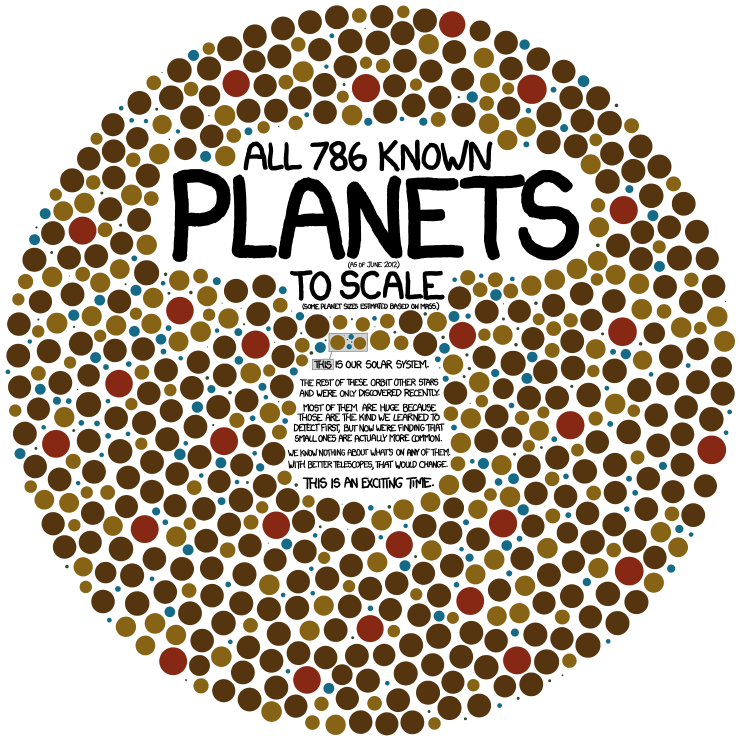
Nope. Not to scale. Jupiter is as big as planets get. If planets get heavier than Jupiter, they become denser, not bigger.pogo wrote:
http://en.wikipedia.org/wiki/Jupiter
Theoretical models indicate that if Jupiter had much more mass than it does at present, the planet would shrink.[26] For small changes in mass, the radius would not change appreciably, and above about 500 M⊕ (1.6 Jupiter masses)[26] the interior would become so much more compressed under the increased gravitation force that the planet's volume would decrease despite the increasing amount of matter. As a result, Jupiter is thought to have about as large a diameter as a planet of its composition and evolutionary history can achieve. The process of further shrinkage with increasing mass would continue until appreciable stellar ignition is achieved as in high-mass brown dwarfs around 50 Jupiter masses.[27]
"My way is the way of not fighting":- the book of Enter the Dragon.

-
pogo

- Sheepie Whore
- Posts: 14180
- Joined: Tue Sep 10, 2002 8:28 pm 0
- Yahoo Messenger: BrassSparrow
- Location: County Durham
Re: SPACE
"As a result, Jupiter is thought to have about as large a diameter as a planet of its composition and evolutionary history can achieve."
So larger exoplanets cannot be made of the same stuff and be the same age as Jupiter. There's only one Jupiter and we don't know how good a model it is for other planets.
Remember that we're much better at finding planets that are close to a star, usually much closer even than Mercury, so they are very unlike Jupiter in that too. Probably if Jupiter were as close to the sun as many of these are it would have had most of its outer layers burned off and be much smaller itself. It may be a very long time, if it happens at all, before we get a good look at even one of these.
-
zip accident
- Sheepie Whore
- Posts: 13928
- Joined: Sun Feb 20, 2005 1:58 pm 0
- Location: Bristol, UK
Re: SPACE
They may have said heavier and not made it clear to Journalists that that meant smaller.gravy wrote:I thought they'd found loads of gas giants around other stars bigger than Jupiter?
So a bigger rocky planet than Jupiter might be possible?pogo wrote:"As a result, Jupiter is thought to have about as large a diameter as a planet of its composition and evolutionary history can achieve."
It would have to be much heavier to get to the same size. I'm not sure there's likely to be that much rock in any one solar system. There is a lot of ice in the Oort (counting solid hydrogen etc. as ice), but I don't think much rock is expected there. Since rock doesn't flame on under compression, I suppose stellar mass rocky objects are not impossible. I don't think any have definitively been found yet.
http://en.wikipedia.org/wiki/Super-Earth
I still think they mean heavier, but if "larger" is actually a direct quote from the team, maybe there is something else going on.On 5 December 2011, the Kepler team announced that they had discovered 2,326 planetary candidates, of which 207 are similar in size to Earth, 680 are super-Earth-size, 1,181 are Neptune-size, 203 are Jupiter-size and 55 are larger than Jupiter.
Last edited by zip accident on Wed Jun 20, 2012 3:42 pm 0, edited 1 time in total.
"My way is the way of not fighting":- the book of Enter the Dragon.

Re: SPACE
"More massive" they might have said.zip accident wrote:They may have said heavier and not made it clear to Journalists that that meant smaller.gravy wrote:I thought they'd found loads of gas giants around other stars bigger than Jupiter?
I thought their was bigger ones too, mind.
-
want to read eye-wateringly bad stories? No? Ok.
want to read eye-wateringly bad stories? No? Ok.
-
zip accident
- Sheepie Whore
- Posts: 13928
- Joined: Sun Feb 20, 2005 1:58 pm 0
- Location: Bristol, UK
Re: SPACE
I would have too, if I hadn't remembered something like that Wikipedia quote.Darkflame wrote:I thought their was bigger ones too, mind.
Actually, thinking about it I suspect that rock does flame on if there's enough, but I would expect there to need to be a higher gravity than to start hydrogen burning.
"My way is the way of not fighting":- the book of Enter the Dragon.
-
pogo
- Sheepie Whore
- Posts: 14180
- Joined: Tue Sep 10, 2002 8:28 pm 0
- Yahoo Messenger: BrassSparrow
- Location: County Durham
Re: SPACE
The problem is we don't know, and it is rather complex. E.g. our solar system is it's thought a second or third generation one, in that the material that makes it up could not have come from our sun but must have come from the processes at the end of a life cycle of a previous star or stars. Who's to say some other planetary system won't have a lot more heavier elements because it benefitted from more, larger or just different stellar collapses before it formed?zip accident wrote:It would have to be much heavier to get to the same size. I'm not sure there's likely to be that much rock in any one solar system.
All we have right now is the approximate size and/or mass of a few hundred exoplanets. They tend to be large because they are easier to detect optically as they pass in front of the star, and heavy as then their effect on their star can be detected. And they are mostly close to their star as we've only been searching for a few years, not long enough for the effect of planets with orbits of many years to be detected. So maybe they are anomalous. They are very different from Jupiter, which formed much further from the sun than most of them, so maybe it is the odd one out. Or maybe small rocky planets like ours are rare, and most planetary systems are filled with giants. We really don't know.
-
zip accident
- Sheepie Whore
- Posts: 13928
- Joined: Sun Feb 20, 2005 1:58 pm 0
- Location: Bristol, UK
Re: SPACE
This solar system is 99.9 % gas. Other ones might have more rock. However the odds of one having enough more rock to create a Jupiter *diameter* rocky planet seem very low. There probably is one somewhere.pogo wrote:The problem is we don't know, and it is rather complex. E.g. our solar system is it's thought a second or third generation one, in that the material that makes it up could not have come from our sun but must have come from the processes at the end of a life cycle of a previous star or stars. Who's to say some other planetary system won't have a lot more heavier elements because it benefitted from more, larger or just different stellar collapses before it formed?zip accident wrote:It would have to be much heavier to get to the same size. I'm not sure there's likely to be that much rock in any one solar system.
I just saw the source of that diagram:
http://xkcd.com/1071/
It expands:
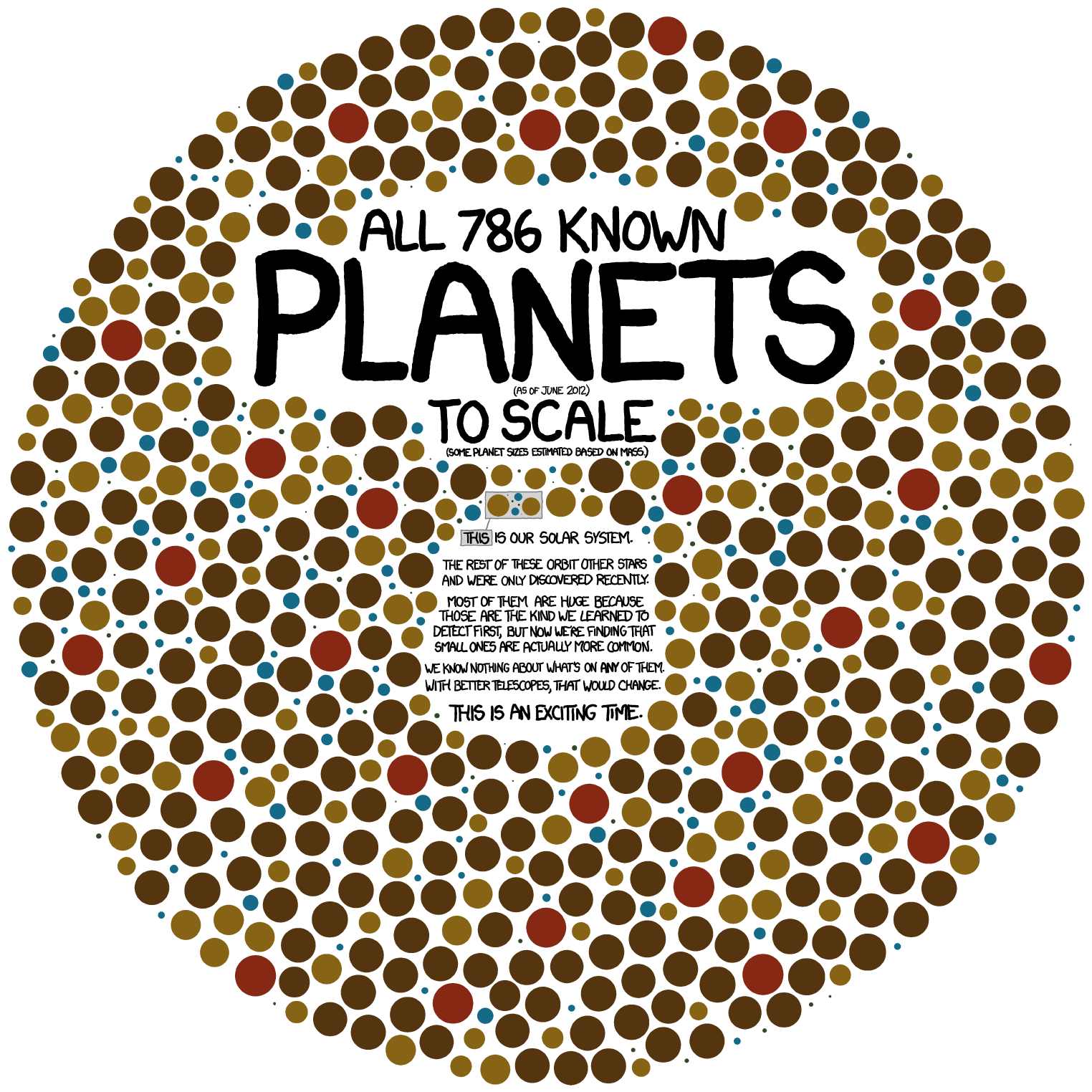
So, that's sort of cleared up, a pity it wasn't strictly masses not sizes, because then it would have been good.Some planet sizes estimated based on mass
We don't know exactly, but we know theoretically how gas giants ought to work, on the basis of what we know about gases. I suspect that the gas giants that have been found are taken to be gas giants on the basis of their mass alone, there might be a rock giant in amongst them.All we have right now is the approximate size and/or mass of a few hundred exoplanets. They tend to be large because they are easier to detect optically as they pass in front of the star, and heavy as then their effect on their star can be detected. And they are mostly close to their star as we've only been searching for a few years, not long enough for the effect of planets with orbits of many years to be detected. So maybe they are anomalous. They are very different from Jupiter, which formed much further from the sun than most of them, so maybe it is the odd one out. Or maybe small rocky planets like ours are rare, and most planetary systems are filled with giants. We really don't know.
"My way is the way of not fighting":- the book of Enter the Dragon.
-
pogo
- Sheepie Whore
- Posts: 14180
- Joined: Tue Sep 10, 2002 8:28 pm 0
- Yahoo Messenger: BrassSparrow
- Location: County Durham
Re: SPACE
''99.9% gas" is wrong as most of it's not in gas form. It's plasma (in the Sun) or whatever state of matter it is deep in Jupiter (the pressure will be much too high for gas). But even so we really don't know. We can't extrapolate from our own solar system, especially as the exoplanets we're finding simply don't fit.zip accident wrote:This solar system is 99.9 % gas. Other ones might have more rock. However the odds of one having enough more rock to create a Jupiter *diameter* rocky planet seem very low. There probably is one somewhere.
...
We don't know exactly, but we know theoretically how gas giants ought to work, on the basis of what we know about gases. I suspect that the gas giants that have been found are taken to be gas giants on the basis of their mass alone, there might be a rock giant in amongst them.
And we certainly can't extrapolate from Jupiter. There's so much about it we don't know such as what gives it's most prominent surface feature the Great Red Spot its red colour. And the surface is the only bit we can investigate as we can't land or go inside it. We can peer at it and measure its gravity but not much else. It is likely unique among any thousand planets and can't easily be used to predict the properties of others.
-
zip accident
- Sheepie Whore
- Posts: 13928
- Joined: Sun Feb 20, 2005 1:58 pm 0
- Location: Bristol, UK
Re: SPACE
Gas as in elements that are gaseous on Earth. Mainly hydrogen. Most of it in the Sun. Since the sun converts hydrogen to helium, there's probably a lot of that too, but that is also a gas (on Earth).pogo wrote:''99.9% gas" is wrong as most of it's not in gas form. It's plasma (in the Sun) or whatever state of matter it is deep in Jupiter (the pressure will be much too high for gas). But even so we really don't know. We can't extrapolate from our own solar system, especially as the exoplanets we're finding simply don't fit.zip accident wrote:This solar system is 99.9 % gas. Other ones might have more rock. However the odds of one having enough more rock to create a Jupiter *diameter* rocky planet seem very low. There probably is one somewhere.
...
We don't know exactly, but we know theoretically how gas giants ought to work, on the basis of what we know about gases. I suspect that the gas giants that have been found are taken to be gas giants on the basis of their mass alone, there might be a rock giant in amongst them.
We have four gas giants in the system to extrapolate from, and the sun.And we certainly can't extrapolate from Jupiter. There's so much about it we don't know such as what gives it's most prominent surface feature the Great Red Spot its red colour. And the surface is the only bit we can investigate as we can't land or go inside it. We can peer at it and measure its gravity but not much else. It is likely unique among any thousand planets and can't easily be used to predict the properties of others.
"My way is the way of not fighting":- the book of Enter the Dragon.


Re: SPACE
...at room temperature, at standard sea-level atmospheric pressure, in ordinary and normal conditions...et cetera.zip accident wrote:Gas as in elements that are gaseous on Earth.
(I know what you mean. I'm just chipping in the extra qualifications necessary - as temperature and pressure comes into this too - to attempt to cut off any ambiguity or misunderstanding. Because this is the Internet and we all know what the Internet can be like on a bad day. Give it an inch, it will take several thousand miles.)
Last edited by KlaxonCow on Wed Jun 20, 2012 10:38 pm 0, edited 1 time in total.
"Words ought to be a little wild - for they are assaults of thought on the unthinking."
- John Maynard Keynes
- John Maynard Keynes
-
pogo
- Sheepie Whore
- Posts: 14180
- Joined: Tue Sep 10, 2002 8:28 pm 0
- Yahoo Messenger: BrassSparrow
- Location: County Durham
Re: SPACE
And not in more complex compounds: almost all the hydrogen on Earth is liquid as it's locked up in water molecules. Free diatomic hydrogen is a gas but any that's formed (or was formed in the past) escapes the atmosphere as it's too light, along with any helium.KlaxonCow wrote:...at room temperature, at standard sea-level atmospheric pressure, in ordinary and normal conditions...et cetera.zip accident wrote:Gas as in elements that are gaseous on Earth.
Re: SPACE
Yes, that too. Elements can behave differently inside compounds than how they'd behave, in the same conditions, on their lonesome outside a compound.pogo wrote:And not in more complex compounds [...]
I knew I'd forget something. Hence the use of an "et cetera" at the end, as a "catch all" clause for everything else I would inevitably forget to include.

"Words ought to be a little wild - for they are assaults of thought on the unthinking."
- John Maynard Keynes
- John Maynard Keynes
-
zip accident
- Sheepie Whore
- Posts: 13928
- Joined: Sun Feb 20, 2005 1:58 pm 0
- Location: Bristol, UK
Re: SPACE
I remember this from O level physics (it was probably a digression, but interesting). It's not that hydrogen and helium are light and float away, it's that they are light, and so the kinetic energy they pick up in collisions with other gas molecules in the atmosphere is enough to take the individual molecules above escape velocity for the Earth.pogo wrote:And not in more complex compounds: almost all the hydrogen on Earth is liquid as it's locked up in water molecules. Free diatomic hydrogen is a gas but any that's formed (or was formed in the past) escapes the atmosphere as it's too light, along with any helium.KlaxonCow wrote:...at room temperature, at standard sea-level atmospheric pressure, in ordinary and normal conditions...et cetera.zip accident wrote:Gas as in elements that are gaseous on Earth.

Which is why in the long run, a planet with the gravity of Mars, will not have a breathable atmosphere, the escape velocity is too low, and gases as light as oxygen and nitrogen fly away.
"My way is the way of not fighting":- the book of Enter the Dragon.