Well, yes, 'float away' is a gross simplification. Nothing 'floats' really: everything is more accurately described in terms of uncountable number of collisions between molecules due to electrostatic forces. So perhaps more precisely hydrogen and helium don't stay for long as the gravitational force on them is too weak to prevent them leaving due to collisions with other molecules in the atmosphere.
Related to earlier posts the point of a 'gas giant' is it's only when they get to Uranus/Neptune mass that planets can hold onto their hydrogen and helium gravitationally, and as the universe is mostly H and He they can then accumulate rather a lot of it so are mostly gas. It's also why we have a few small planets, a few large ones and a large gap between in size. This of course could happen in other star systems, which would mean there could be many Earth-like planets out there, just too small to detect.
SPACE
-
teamonkey

- Sheepie Whore

- Posts: 12082
- Joined: Thu Jun 13, 2002 1:07 am 0
- XBL Gamertag: itsthetaste
- PSN: teamonkey_ca
- Contact:
Re: SPACE
I get your point, I think the XKCD dude scaled up the size of the circles based on the planet's mass vs. Jupiter's size. We haven't actually seen light from most of these planets, just inferred their position and mass.zip accident wrote:Nope. Not to scale. Jupiter is as big as planets get. If planets get heavier than Jupiter, they become denser, not bigger.
But there's a few things that could potentially make them bigger. Firstly, if Jupiter's chemical composition was different it could have a different density and radius. Also, AFAIK we're still not sure if Jupiter has a solid core or not or exactly how big that core is. We know its size, mass and density very accurately but we're still not sure exactly how that's distributed inside.
The other thing is that most of the earlier planets were hotter than Jupiter. The earlier techniques to find planets used a method that could only find large, heavy planets that were very reflective and relatively close to the star (I think it's about 1AU). This implies that most of the planets would be hot and that would make them expand.
-
Ratsoap

- Baaaaaaa!

- Posts: 6344
- Joined: Fri Dec 19, 2003 1:46 pm 0
- Location: Back in Edinburgh
- Contact:
Re: SPACE
It's a solid diamond the size of earth. Duh.teamonkey wrote:
Also, AFAIK we're still not sure if Jupiter has a solid core or not or exactly how big that core is.

Because fucking marketing cunts would never call a spade anything other than a Deluxe Easi-Shift Earth Movement Solution.

-
zip accident

- Sheepie Whore
- Posts: 13928
- Joined: Sun Feb 20, 2005 1:58 pm 0
- Location: Bristol, UK
Re: SPACE
Heating gases on Earth's surface makes them expand. Under dramatically more pressure I'm not certain that would work in quite such a simple way, it might cause increased pressure which might precipitate them out as liquids, that depends on the angles on the phase diagrams of the gases in question, I remember water being different to CO2, which is why CO2 "ice" sublimes and ice melts, but I have no idea whether hydrogen and helium are both like water, or whether either of them are like CO2.teamonkey wrote:The other thing is that most of the earlier planets were hotter than Jupiter. The earlier techniques to find planets used a method that could only find large, heavy planets that were very reflective and relatively close to the star (I think it's about 1AU). This implies that most of the planets would be hot and that would make them expand.
"My way is the way of not fighting":- the book of Enter the Dragon.
-
pogo

- Sheepie Whore
- Posts: 14180
- Joined: Tue Sep 10, 2002 8:28 pm 0
- Yahoo Messenger: BrassSparrow
- Location: County Durham
Re: SPACE
I don't know it makes sense to describe them as 'like CO2'. We know that CO2 sublimes as it happens at temperatures and pressures we're experienced with; in particular it's triple point is at around 5 atmospheres, and below that pressure it only exists as solid and gas. But water sublimes with a low enough pressure, as would many other materials.
Outside of the liveable zone of Earth pressures and temperatures vary wildly. Only a few miles below us it's hot enough that rock is liquid, while a few miles up the pressure drops precipitously. Gas giants with much deeper atmospheric regions will experience much greater pressure under all that weight of atmosphere and much higher pressures. So it's likely all elements and molecules are in very different forms to here.
It gets hot inside planets as the energy of all the parts colliding together to form a planet generate a lot of heat. It's why the Earth still has an energetic molten core billions of years after it was formed. Larger planets with even more mass which arrived even faster should be much hotter. And of course their higher gravity will mean much higher pressures.
-
teamonkey
- Sheepie Whore
- Posts: 12082
- Joined: Thu Jun 13, 2002 1:07 am 0
- XBL Gamertag: itsthetaste
- PSN: teamonkey_ca
- Contact:
SPACE
Yep, it does. The gas laws don't break down even as you approach the pressures required for fusion in stars. No special rules or caveats for planetary atmospheres.zip accident wrote: Under dramatically more pressure I'm not certain that would work in quite such a simple way,
-
axel000

- Baaaaaa!

- Posts: 2905
- Joined: Thu Sep 29, 2005 4:02 am 0
- PSN: huckwee
- Location: Philadelphia, USA
Re: SPACE
Good to see the chinese starting to make progress in space; maybe this will give the US Congress the scare it needs to start spending like Apollo again 
http://online.wsj.com/article/SB1000142 ... 72174.html


http://online.wsj.com/article/SB1000142 ... 72174.html
~~~~~~~~~~~~~~~~~~~~~~~~~~~~~~~~~~~~~~~~~~~~~~~~~
Gamertags:
[Steam] scottish_usa
[PSN] huckwee
[Star Citizen] Zander9
~~~~~~~~~~~~~~~~~~~~~~~~~~~~~~~~~~~~~~~~~~~~~~~~~
Gamertags:
[Steam] scottish_usa
[PSN] huckwee
[Star Citizen] Zander9
~~~~~~~~~~~~~~~~~~~~~~~~~~~~~~~~~~~~~~~~~~~~~~~~~
-
zip accident
- Sheepie Whore
- Posts: 13928
- Joined: Sun Feb 20, 2005 1:58 pm 0
- Location: Bristol, UK
Re: SPACE
Yeah, but the slope of the one graph is to the left, the other to the right. The result of that if I remember rightly is that as water is pressured the freezing point rises, whereas with CO2, the freezing point drops with increasing pressure, again I think it's water that's unusual.pogo wrote:I don't know it makes sense to describe them as 'like CO2'. We know that CO2 sublimes as it happens at temperatures and pressures we're experienced with; in particular it's triple point is at around 5 atmospheres, and below that pressure it only exists as solid and gas. But water sublimes with a low enough pressure, as would many other materials.
I'm told that it's not liquid, it moves about but it's in some sense solid, it liquifies when the pressure on it drops when it gets to the surface, I don't feel comfortable with that, but it's what I am told.Only a few miles below us it's hot enough that rock is liquid
That is more or less what I was saying in my posts above.Outside of the liveable zone of Earth pressures and temperatures vary wildly. Only a few miles below us it's hot enough that rock is liquid, while a few miles up the pressure drops precipitously. Gas giants with much deeper atmospheric regions will experience much greater pressure under all that weight of atmosphere and much higher pressures. So it's likely all elements and molecules are in very different forms to here.
It gets hot inside planets as the energy of all the parts colliding together to form a planet generate a lot of heat. It's why the Earth still has an energetic molten core billions of years after it was formed. Larger planets with even more mass which arrived even faster should be much hotter. And of course their higher gravity will mean much higher pressures.
Yes, but the gas laws only apply to gases, I suspect that from earth surface atomosphere density inward the gases in a gas giant planet may be liquid, plasma or solid, and I don't know how those react to pressure changes, phase changes can do interesting things.teamonkey wrote:Yep, it does. The gas laws don't break down even as you approach the pressures required for fusion in stars. No special rules or caveats for planetary atmospheres.
I still hope they've got a man and wife up there, and get the first conception in space.axel000 wrote:Good to see the chinese starting to make progress in space; maybe this will give the US Congress the scare it needs to start spending like Apollo again
"My way is the way of not fighting":- the book of Enter the Dragon.
-
teamonkey
- Sheepie Whore
- Posts: 12082
- Joined: Thu Jun 13, 2002 1:07 am 0
- XBL Gamertag: itsthetaste
- PSN: teamonkey_ca
- Contact:
Re: SPACE
Phase changes do VERY predictable things and the laws have been defined for hundreds of years. We're not talking about bose-einstein condensations or anything like that. For a planet the pressures involved aren't that extreme; you'd be heading into brown dwarf territory for that.zip accident wrote: Yes, but the gas laws only apply to gases, I suspect that from earth surface atomosphere density inward the gases in a gas giant planet may be liquid, plasma or solid, and I don't know how those react to pressure changes, phase changes can do interesting things.
If you remember phase-change diagrams from high school, each substance has different behaviour depending on temperature and pressure.
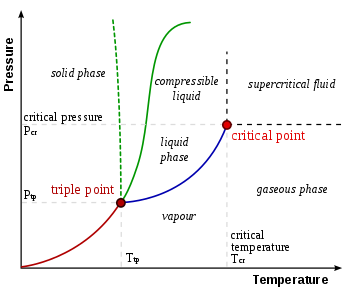
(Supercritical is an unstable state that is extremely sensitive to pressure and temperature changes and will quickly diverge into a liquid or gas)
You can't just increase pressure and expect it to turn into a liquid. You have to cool the gas also, or at least make sure that the balance of pressure and temperature fits. One other important thing to remember is that temperature isn't always intuitive. The upper atmosphere has a temperature of 1250 K but the air pressure is so low that it feels very cold.
In astrophysics, the difference between the triple point and critical point is tiny (e.g. in water - a measly 100 K/500kPa difference) so planetary astrophysicists tend to ignore it unless they're looking really hard at the composition.
So you combine that with the equations for hydrostatic equilibrium, which is how the gas pressure increases by gravity, but is balanced out by the pressure of the more-compressed gas closer to the planet.
-
zip accident
- Sheepie Whore
- Posts: 13928
- Joined: Sun Feb 20, 2005 1:58 pm 0
- Location: Bristol, UK
Re: SPACE
Well, I suspect that mass loss due to heating will be a more significant effect than expansion due to heating, but anyway I believe the expansion won't be to the sizes on the xkcd diagram. The xkcd guy does nice diagrams, usually very informative, it's sad this one was ambiguous.teamonkey wrote:Phase changes do VERY predictable things and the laws have been defined for hundreds of years. We're not talking about bose-einstein condensations or anything like that. For a planet the pressures involved aren't that extreme; you'd be heading into brown dwarf territory for that.zip accident wrote: Yes, but the gas laws only apply to gases, I suspect that from earth surface atomosphere density inward the gases in a gas giant planet may be liquid, plasma or solid, and I don't know how those react to pressure changes, phase changes can do interesting things.
If you remember phase-change diagrams from high school, each substance has different behaviour depending on temperature and pressure.
(Supercritical is an unstable state that is extremely sensitive to pressure and temperature changes and will quickly diverge into a liquid or gas)
You can't just increase pressure and expect it to turn into a liquid. You have to cool the gas also, or at least make sure that the balance of pressure and temperature fits. One other important thing to remember is that temperature isn't always intuitive. The upper atmosphere has a temperature of 1250 K but the air pressure is so low that it feels very cold.
In astrophysics, the difference between the triple point and critical point is tiny (e.g. in water - a measly 100 K/500kPa difference) so planetary astrophysicists tend to ignore it unless they're looking really hard at the composition.
So you combine that with the equations for hydrostatic equilibrium, which is how the gas pressure increases by gravity, but is balanced out by the pressure of the more-compressed gas closer to the planet.
"My way is the way of not fighting":- the book of Enter the Dragon.
-
teamonkey
- Sheepie Whore
- Posts: 12082
- Joined: Thu Jun 13, 2002 1:07 am 0
- XBL Gamertag: itsthetaste
- PSN: teamonkey_ca
- Contact:
SPACE
You can do a back-of-the-envelope calculation and see whether the heating will cause mass loss by using kinetic theory to work out the mean-square velocity of gas particles and see if they exceed the escape velocity.
-
Muttley

- Sheepie Whore
- Posts: 13169
- Joined: Thu Apr 25, 2002 12:30 pm 0
- XBL Gamertag: Mu77ley
- Location: In a maze of twisty passages, all alike.
- Contact:
Re: SPACE
SpaceX test the new Merlin 1D engine:
Muttley's Blog: Rarely updated, occasionally interesting… maybe
RetroRemakes Framework: Open Source BlitzMax Game Framework
MuttMod: My Open Source BlitzMax Modules
RetroRemakes Framework: Open Source BlitzMax Game Framework
MuttMod: My Open Source BlitzMax Modules
-
Muttley
- Sheepie Whore
- Posts: 13169
- Joined: Thu Apr 25, 2002 12:30 pm 0
- XBL Gamertag: Mu77ley
- Location: In a maze of twisty passages, all alike.
- Contact:
Re: SPACE
Muttley's Blog: Rarely updated, occasionally interesting… maybe
RetroRemakes Framework: Open Source BlitzMax Game Framework
MuttMod: My Open Source BlitzMax Modules
RetroRemakes Framework: Open Source BlitzMax Game Framework
MuttMod: My Open Source BlitzMax Modules
-
axel000
- Baaaaaa!
- Posts: 2905
- Joined: Thu Sep 29, 2005 4:02 am 0
- PSN: huckwee
- Location: Philadelphia, USA
Re: SPACE
Interesting - lab tests in mice may have revealed that existing approved medications may provide significant protection against high doses of radiation. Could be a useful avenue of exploration for long duration space missions.
http://science.slashdot.org/story/12/06 ... ation-dose
http://science.slashdot.org/story/12/06 ... ation-dose
http://www.nature.com/nm/journal/vaop/n ... .2813.html"Two anti-clotting compounds already approved for use in humans may have a surprising role in treating radiation sickness. Last year's nuclear accident in Fukushima, Japan renewed anxiety over the lack of treatments for radiation poisoning. It was long thought that the effects of exposure to high doses of radiation were instantaneous and irreversible, leading to destruction of the gut and loss of bone marrow cells, which damages blood-cell production and the immune system. The two compounds are thrombomodulin (Solulin/Recomodulin), currently approved in Japan to prevent thrombosis, and activated protein C (Xigris). Treating mice with either drug post-exposure led to an eightfold increase in key bone marrow cells needed for the production of white blood cells, and improved the survival rates of mice receiving lethal radiation doses by 40–80%
~~~~~~~~~~~~~~~~~~~~~~~~~~~~~~~~~~~~~~~~~~~~~~~~~
Gamertags:
[Steam] scottish_usa
[PSN] huckwee
[Star Citizen] Zander9
~~~~~~~~~~~~~~~~~~~~~~~~~~~~~~~~~~~~~~~~~~~~~~~~~
Gamertags:
[Steam] scottish_usa
[PSN] huckwee
[Star Citizen] Zander9
~~~~~~~~~~~~~~~~~~~~~~~~~~~~~~~~~~~~~~~~~~~~~~~~~