pogo wrote:Rubber sheets are perhaps a crude analogy as if you tried to set up an experiment with such sheets and e.g. similar size orbiting masses you'd quickly run into problems with energy loss as the sheet dissipated energy as it stretched and rebounded.
I was referring to Yakyak's previous discussions of the analogy. It's not a good analogy, IMO, and it's right that that was proved. A good analogy can lead to new insights and the generation of new hypotheses, but this analogy isn't that interesting.
"My way is the way of not fighting":- the book of Enter the Dragon.
Perhaps one based on density would be better? Not sure how exactly, but rather then using gravity to explain gravity,
you have some glass material with a varying density? So the path of a beam would curve......and I dont know where I am going with this.
Darkflame wrote:Perhaps one based on density would be better? Not sure how exactly, but rather then using gravity to explain gravity,
you have some glass material with a varying density? So the path of a beam would curve......and I dont know where I am going with this.
Hm, interesting. I'm not sure whether it leads anywhere.
"My way is the way of not fighting":- the book of Enter the Dragon.
Darkflame wrote:Perhaps one based on density would be better? Not sure how exactly, but rather then using gravity to explain gravity,
you have some glass material with a varying density? So the path of a beam would curve......and I dont know where I am going with this.
I don't think this will work for a couple of reasons. First the point of gravity, whether for real or modelled by a curved and sloped surface, is it works in one direction. Refraction doesn't: the refraction at e.g. a air-glass boundary deflects in multiple directions, or not at all, depending on the direction of the incident beam. Second you can't in general vary the density of a solid: it's fixed, right up until you create a neutron star and compress matter so much that atoms collapse in on themselves. You can vary the material but not smoothly and continuously (you can't e.g. blend ice and glass smoothly to vary the refractive index).
On the rubber sheet sure it's imperfect but that doesn't make it a bad analogy. The best way to describe it I think is an idealised rubber sheet would be a good model, but rubber is far from idealised. Rubber has mass and inertia, does work (so loses energy), doesn't move instantaneously, stores energy and can rebound and even oscillate. The thinner/tauter you can make it without breaking the better but it will never be perfect.
I was thinking with glass if you made it thickly and put a precisely shaped very heavy weight above to apply varying pressure to it. Obviously that would only work in 2D and not sure how deformable glass is under compression without breaking.
But, yes, I guess its not a good fit anyway as its not one way as you say.
Instinctively I feel something with density might work though. As (sort of) a planet could be seen as making space "more dense" in its gravitational well no?
On the other hand, things tend to move towards less dense area's and reach an equilibrium. So the analogy would be the other way around if related to any non-gravity phenomenon. ho hum :-/
Darkflame wrote:Perhaps one based on density would be better? Not sure how exactly, but rather then using gravity to explain gravity,
you have some glass material with a varying density? So the path of a beam would curve......and I dont know where I am going with this.
I don't think this will work for a couple of reasons. First the point of gravity, whether for real or modelled by a curved and sloped surface, is it works in one direction. Refraction doesn't: the refraction at e.g. a air-glass boundary deflects in multiple directions, or not at all, depending on the direction of the incident beam. Second you can't in general vary the density of a solid: it's fixed, right up until you create a neutron star and compress matter so much that atoms collapse in on themselves. You can vary the material but not smoothly and continuously (you can't e.g. blend ice and glass smoothly to vary the refractive index).
No, but with fluids it might be possible. I suspect you'd have to use gravity to change the densitities, but even so it would be better than that rubber chicken abortion.
On the rubber sheet sure it's imperfect but that doesn't make it a bad analogy.
Being a bad analogy does that, and it is.
The best way to describe it I think is an idealised rubber sheet would be a good model, but rubber is far from idealised. Rubber has mass and inertia, does work (so loses energy), doesn't move instantaneously, stores energy and can rebound and even oscillate. The thinner/tauter you can make it without breaking the better but it will never be perfect.
Even if it was perfect idealised semi-rubber, it wouldn't be a good analogy.
"My way is the way of not fighting":- the book of Enter the Dragon.
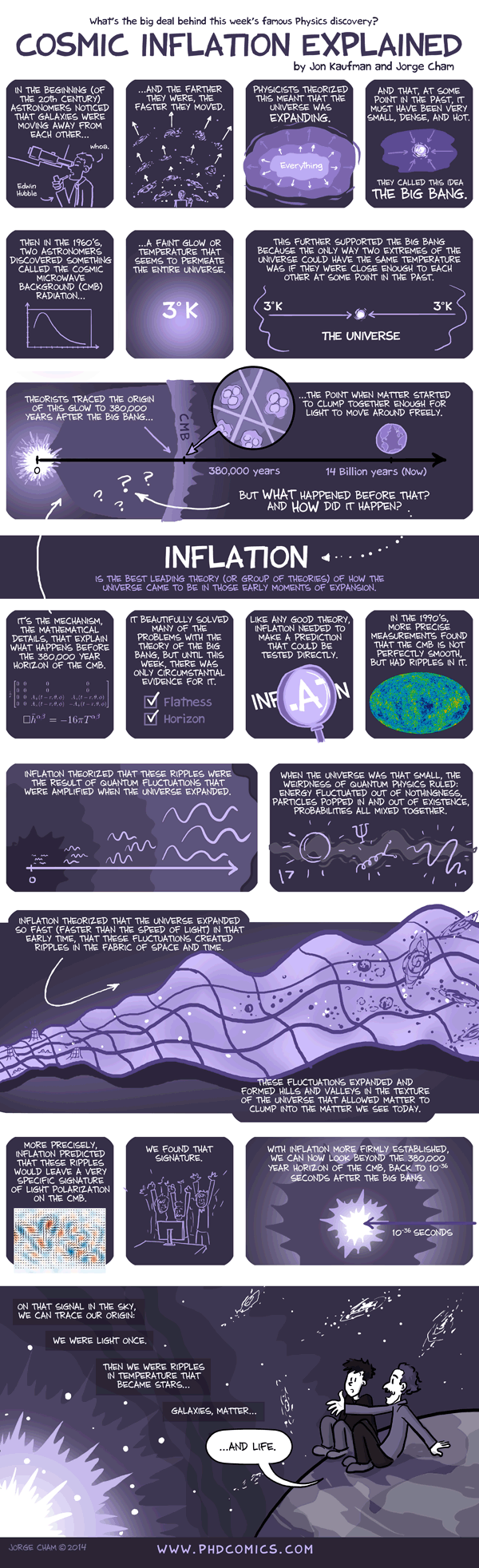
Not a question but so good I have to post it. If you like it's a brilliantly done answer to the question "what is [cosmic] inflation and why do we think it happened?"
It's still impressive, that they've been able to do science to support, if not prove 100%, the theory of inflation.
By 'do science' I mean the scientific method. Normally to do science you come up with a theory, then devise experiments to test it. Experiments always involve making predictions then seeing how they turn out. They can be simple lab experiments, or trials as used to test medicines, or even experiments with large bodies of people, such as measuring the effects of govt. policies.
Doing experiments in cosmology is hard though. You have no control over the stars, you can only watch, and it all happens far too slowly for most predictions to be tested. In theory you can make predictions then look for evidence in new observations to confirm them. But that's hard as there aren't many new observations to make: we've mapped the sky pretty thoroughly. Things able to do new observations, such as new satellites, often aren't able to look at what you want, as they've been sent up for very narrow reasons.
Cosmology is full of theories based on observations, which are in some sense unsatisfactory because of it. The theory may be fine but you can't be sure some better theory won't come along, as we fill in some of the many other gaps in our knowledge. So it's nice they've come up with an experiment which provides at least partial evidence, even if there are other possible explanations.