A Conservative government would end inheritance tax on family homes worth up to £1m, David Cameron is to announce.
Which just means that anyone with £1m or more who wanted to minimise inheritance tax would buy an expensive house. So it’s just raising the limit to £1m, nothing to do with “family homes”. Besides, the fact that homes can be worth so much points to another failure of this and previous governments, to not do anything about the housing shortage that’s been building for decades.
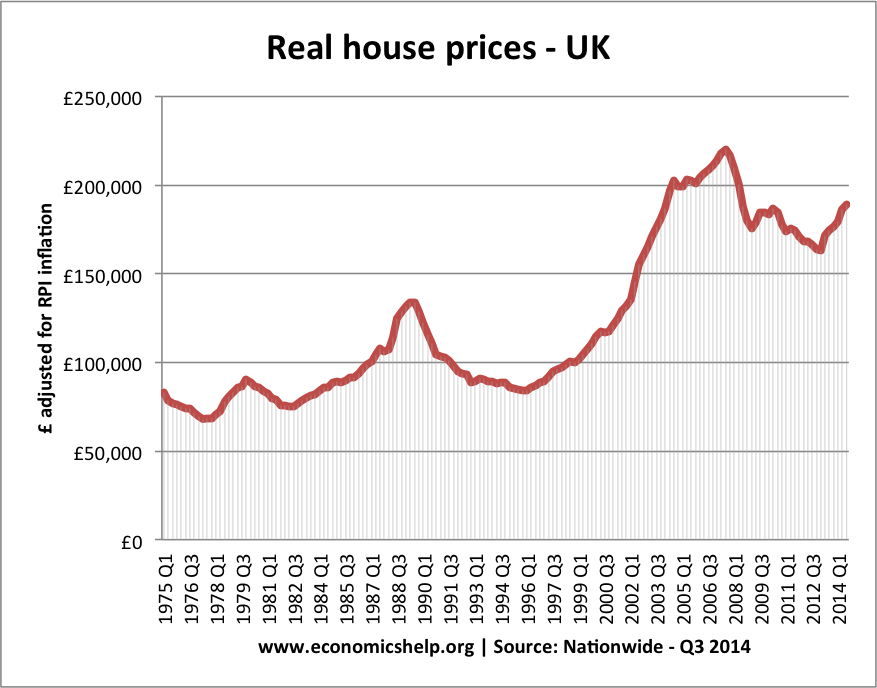
Not relevant; the underlying problem is not enough homes being built. I wrote “decades” as we had a housing bust in the early 1990s. The market is horribly cyclical but after a boom in the late 1980s prices fell again to normal levels in the mid 1990s, so was working as expected. But things have changed since.
After 1995 prices kept rising steadily for a decade to never before seen levels. Many expected a massive bust after that massive boom when the economy experienced its worst crash since before the war. But it barely happened; prices wobbled but hardly fell and have resumed their inexorable rise.
And those are real prices. Given that wages fell in real terms in the first couple of years of the recession relative to wages it would look even worse. And of course it’s much worse in London, where real prices have already exceeded the levels reached before the recession hit.
The transfer of houses from public/social to private though does not change the underlying supply or stock, and the market carried on as normal (where “normal” means our usual cycle of boom and bust) into the mid 1990s.
What changed after the mid 1990s? Immigration mostly; as the economy boomed and the EU expanded immigration grew under Labour and has stayed high since, with only a brief drop around the start of this parliament. People are right to identify immigration as a large contributor to high house prices.
But that’s what we get from being in the EU, and being one of the best performing EU economies both before and after the crash. The government can’t pass the buck and blame anyone else, they have to manage it, by e.g. getting more houses built. Reducing immigration isn’t really an option, unless we leave the EU. But that would be a very bad idea for other reasons: it would have many other costs and consequences than just reducing immigration.
pogo wrote:Ah, and although this belongs in the Ireland thread it seems very relevant here. I’ve been assuming nothing can upset the arithmetic of a Lab-SNP coalition but there is something:
Six days actually means six working days, as that’s how many there are until a key meeting on the 24th. Time really is running out for Greece financially. They need a deal soon, and this might be their last chance. Problem is most of the things they have done recently have ended up pushing them further away from the rest of the EU: bringing up reparations from Germany again (this time attaching a € figure to them); flying to Moscow to perhaps get help from Putin in exchange for who knows what.
There’s the real possibility they will be, if not out of the euro, then well on the way by the election. In which case it can hardly not be an election issue. It may be a lot like 2010, with the whole of Europe in crisis mode and pressure on politicians here not to waste time but to respond. Probably there’s nothing that can be done here but it does put some issues in perspective such as the pledge to hold a referendum on the EU by 2017 – by then the EU may be radically changed making a referendum a very different matter.
Extended membership of the Euro for basket case economies was the motherlode of economic bad ideas. You can't have monetary union without political union. Let Greece fail. Let the Euro fail. It will fail anyway. The Euro is like a three legged race, except there are 22 legs. And some of those with their ankles tied together are 90 years olds with a broken hip. You can't co-ordinate should a rag-tag fugitive fleet without being able to control all of their interest rates, tax rates and spending plans. Greece might be the first to drop out, but it won't be the last.
You technically only need fiscal union: you need tax and spending decisions taken centrally. So tax is raised across the eurozone according to ability to pay, which would mean proportionately more from richer countries like Germany, Holland. And so more is paid out to poorer citizens, more of whom are in Greece and Spain, for example. Not everything needs to be centralised; as within countries there’s still room for limited local decision making and spending. But the main budget would have to be central.
Which probably does require a much greater degree of political union, such as more powerful central institutions able to make decisions without heads of state looking over their shoulders. Problem is that’s not on the cards. For Germans they are not going to let any supranational body rewrite the rules of the euro so they are permanently subsidising Greece, while probably no EU country is willing to surrender so much fiscal autonomy.
Which means the euro will break up sooner or later. There’s no political will to find a long term solution. Things have been brought to the head by Syriza’s victory but the problems have been building for a long while, since the creation of the euro, and Greece leaving won’t fix them; it might seem to relieve the immediate pressure but it will only bring forward the date when other countries follow Greece out.
Getting back on topic, it doesn’t affect our election, except that it makes the question of the UK leaving more interesting. If Greece leave the EU soon, (because they might have no choice if they leave the euro, say) then other countries may leave within a couple of years, i.e. by the time of a 2017 referendum. In which case being out of the EU won’t be that lonely a place to be. It might take time to rebuild bridges with (what’s left of) the EU but bilateral agreements with other ex-EU countries would be much easier to contemplate.
A Conservative government would end inheritance tax on family homes worth up to £1m, David Cameron is to announce.
Which just means that anyone with £1m or more who wanted to minimise inheritance tax would buy an expensive house. So it’s just raising the limit to £1m, nothing to do with “family homes”. Besides, the fact that homes can be worth so much points to another failure of this and previous governments, to not do anything about the housing shortage that’s been building for decades.
Your right its not a good idea its still being set way too low. 1 Million pounds buys very little in the south east of England, unless its raised every year by the average house price rise its a token gesture. Peg it to the house price rises and its a good policy.
Inheritance tax - Cameron promised to do that in 2010, by cracking down on non-domicile taxpayers.
And there's no mention of HOW they are going to cover the £1 billion cost. Osborne even forced his way onto the Andrew Marr Show this morning to trumpet the idea, and then would not answer the simple question on how it would be funded.
The inheritance tax changes will be paid for by pension changes apparently, the already announced reduction in the amount high earners can put away tax free towards their pensions, effectively taxing them more. Quite canny in a way: few people will care about or notice the pension changes, except those affected who are hardly going to complain about their very generous pensions being taxed a little more. But far more people care about inheritance tax, far more than will ever be effected by it.
So with 300,000 people earning above £150,000, the Tories would be taking probably more than £2bn from the top 1% of taxpayers - many of whom would vote Tory through thick and thin - to give perhaps around £1bn to the children of perhaps one in 10 asset-rich older people, who would also largely vote Tory, presumably.
merman wrote:Inheritance tax - Cameron promised to do that in 2010, by cracking down on non-domicile taxpayers.
And there's no mention of HOW they are going to cover the £1 billion cost. Osborne even forced his way onto the Andrew Marr Show this morning to trumpet the idea, and then would not answer the simple question on how it would be funded.
How on Earth can you trust them?
*slow handclap*
I trust them far more than Labour who in there last try managed to sell off the Gold Assets and leave the country in a terrible state. The country is now only just recovering from the Blair/Brown mismangement. I wont convince you though as you are a dyed in the wool labour supporter.
No, they were right to offload the gold reserves. Sure, if they had waited they might have made more. Or less. Some people may enjoy speculating on the gold price but it’s not for responsible governments to do. Gold earns no interest, so selling it off and using it to pay off the national debt, which you pay interest on (we pay more in interest than the bill for the MOD, it’s not a small amount) was the only sensible thing to do. Gold reserves made sense once (when currencies were backed by gold, many decades ago) but they make no sense now.
Apart from the fact they still left their term of office with huge debts. The Gold was sold off too cheaply and as a result the country was in a poorer state than if it had not sold at that point.
No, it was not sold off too cheaply. You don’t get to choose the price you sell at, there’s just the market price. Waiting might net you more but it might net you less: no-one knew at the time whether the price would rise or fall. And as you wait you earn no interest, just pay costs of storage.
Frankly the gold sale didn’t matter then, and doesn’t matter now. It was the legacy of some long abandoned policy, from when the pound was backed by gold. But that policy ended decades ago. There are many reasons to criticise the Blair/Brown government but this is not one of them.