stupid physics questions


Re: stupid physics questions
Wait, are you attributing the super-light-speed travel of the outer edge of the observable universe to kinetic energy?
-
Absolute_Zero

- Baaaaaa!

- Posts: 3564
- Joined: Wed May 18, 2005 4:11 pm 0
- Location: Hilbert Hotel, Heisenberg.
Re: stupid physics questions
I'm not Dark Energy's greatest fan but...
http://physics.stackexchange.com/questi ... f-universe
...though I rather like the argument that it may all sum to zero.
http://physics.stackexchange.com/questi ... f-universe
...though I rather like the argument that it may all sum to zero.
-
pogo

- Sheepie Whore

- Posts: 14180
- Joined: Tue Sep 10, 2002 8:28 pm 0
- Yahoo Messenger: BrassSparrow
- Location: County Durham
Re: stupid physics questions
Your question makes no sense: if stuff is observable, with light, then it is not travelling at “super-light-speed”. And in fact everything within our observable universe is moving at less than light speed. The edge of it is stuff whose light has just reached us. The observable universe grows with time, with its size in light-years the same as its age in years (although on our timescales the growth is far too slow to perceive – we are talking about looking at distant galaxies separated by millions of light years, so which will take millions of years to become visible). It is heavily red-shifted but visible. Things at the edge are receding quickly but not at light speed.gumboot wrote:Wait, are you attributing the super-light-speed travel of the outer edge of the observable universe to kinetic energy?
We think there are parts of the universe that are moving at greater than light speed, relative to us. But they are not within the observable universe. This does not contradict relativity as the constraint on things not going faster than light speed is only a local constraint. The light speed limit is due to special relativity, but the expansion of the universe at faster than light speed comes from general relativity applied to the universe as a whole.
https://en.wikipedia.org/wiki/Metric_expansion_of_space
-
Absolute_Zero
- Baaaaaa!
- Posts: 3564
- Joined: Wed May 18, 2005 4:11 pm 0
- Location: Hilbert Hotel, Heisenberg.
Re: stupid physics questions
Meanwhile, rumours abound that LIGO has detected two gravitational wave events. We'll see, the announcement is set for Feb 11.
-
Absolute_Zero
- Baaaaaa!
- Posts: 3564
- Joined: Wed May 18, 2005 4:11 pm 0
- Location: Hilbert Hotel, Heisenberg.
Re: stupid physics questions
Next week's big news today.Absolute_Zero wrote:Meanwhile, rumours abound that LIGO has detected two gravitational wave events. We'll see, the announcement is set for Feb 11.
http://motls.blogspot.co.uk/2016/02/lig ... ns-51.html
-
pogo
- Sheepie Whore
- Posts: 14180
- Joined: Tue Sep 10, 2002 8:28 pm 0
- Yahoo Messenger: BrassSparrow
- Location: County Durham
Re: stupid physics questions
Confirmed. Seems it’s not two events but the same event picked up at two detectors, ms apart to give some indication of the source direction.
http://arstechnica.co.uk/science/2016/0 ... nal-waves/
Now they can detect them the real work begins.
http://arstechnica.co.uk/science/2016/0 ... nal-waves/
Now they can detect them the real work begins.
-
pogo
- Sheepie Whore
- Posts: 14180
- Joined: Tue Sep 10, 2002 8:28 pm 0
- Yahoo Messenger: BrassSparrow
- Location: County Durham
Re: stupid physics questions
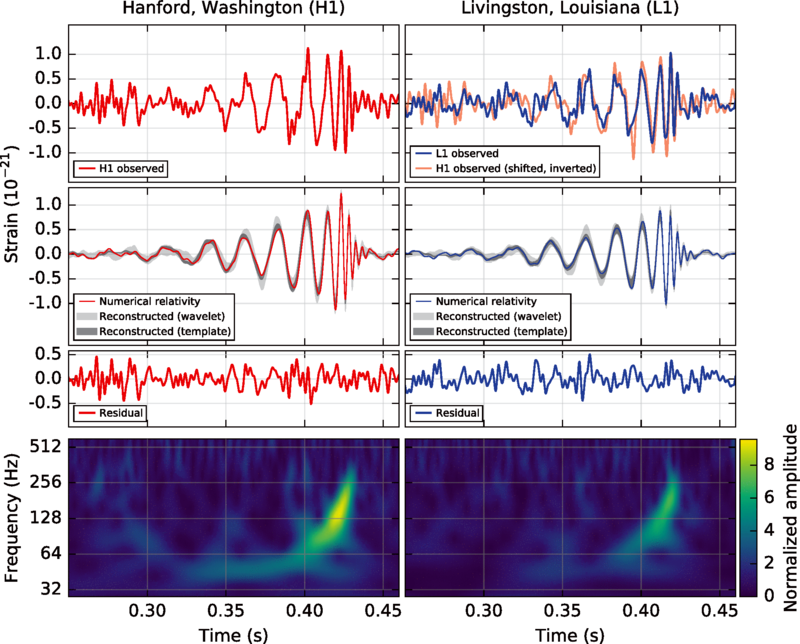
That’s the data in graph form. You can see how they can tell so much from it. The rapidly shortening wavelength is due to the objects in question, black holes many times the mass of the sun, are so close that not only do their orbits take fractions of a second but they are giving up energy every orbit as the spiral in closer, before finally merging. The data from the two sites closely matches, meaning it can only be an actual observation, not a fault or local tremor.
The data is so rich that people will be keen to build more of these at different sites. You will collect exactly the same data but the more detectors you have the better you can pinpoint the direction of the source from the different times the detectors pick up the signal. If these keep happening regularly then they can create a map of them and compare it to existing maps. They will also I think try to find ways to reduce residual noise, to be able to detect smaller events which should occur more often.

Re: stupid physics questions
eLISA should probably get a definite okay now. It'll be to earth based detectors what hubble was to earth based telescopes.

Re: stupid physics questions
What, bloody expensive, badly set up, and impossible to use to peek into your neighbour's bathroom?gravy wrote:eLISA should probably get a definite okay now. It'll be to earth based detectors what hubble was to earth based telescopes.
Really, though, it's fabulous. What we have now is pretty much a camera obscura. But HDTV is coming. Yay scientists.
"massive retard™", "full of shit™", "tiny bitch™", "retarted™", "a bit of a one trick pony™", "petty™", "simple minded idealistic twat™", "miserable humourless fucker™"
Re: stupid physics questions
Well yeah, like Hubble after it'd been to spec savers 
-
Portland

- Baaaaaaa!

- Posts: 8828
- Joined: Thu Apr 06, 2006 8:16 am 0
- Location: Swinton, South Yorkshire
Re: stupid physics questions
So what happens to a weasel in the innards of the LHC?
http://www.bbc.co.uk/news/world-europe-36173247
[edit] This has gone nuts of late, now most read story on the Beeb
http://www.bbc.co.uk/news/world-europe-36173247
[edit] This has gone nuts of late, now most read story on the Beeb
Portland 3.0.1.0 public release rolled out
-
zip accident

- Sheepie Whore
- Posts: 13928
- Joined: Sun Feb 20, 2005 1:58 pm 0
- Location: Bristol, UK
Re: stupid physics questions
Do we have a measurement system that isn't based on local features of the universe?
The metre (and thus the whole SI) is based on the circumference of the Earth, the AU on the distance from the Earth to the Sun, etc.
It seems we ought to be able to derive some units of length from the planck length, and times etc from those.
The metre (and thus the whole SI) is based on the circumference of the Earth, the AU on the distance from the Earth to the Sun, etc.
It seems we ought to be able to derive some units of length from the planck length, and times etc from those.
"My way is the way of not fighting":- the book of Enter the Dragon.


Re: stupid physics questions
SI has been based on physical constraints for decades. Distance is defined in terms of the speed of light and time in terms of nuclear vibrations of specific isotopes, etc. The only one that isn't is mass, which is still defined by a specific physical object, but we're working on that and are scheduled to have a definition in 2018 based either on avogadro's number or the Planck constant, depending on what method of measuring it wins out.zip accident wrote:Do we have a measurement system that isn't based on local features of the universe?
The metre (and thus the whole SI) is based on the circumference of the Earth, the AU on the distance from the Earth to the Sun, etc.
It seems we ought to be able to derive some units of length from the planck length, and times etc from those.
It seemed like a good idea at the time.
-
zip accident
- Sheepie Whore
- Posts: 13928
- Joined: Sun Feb 20, 2005 1:58 pm 0
- Location: Bristol, UK
Re: stupid physics questions
Defined in terms of sure, but its units are still based on metres, which are Earth based.5th Earth wrote:SI has been based on physical constraints for decades. Distance is defined in terms of the speed of lightzip accident wrote:Do we have a measurement system that isn't based on local features of the universe?
The metre (and thus the whole SI) is based on the circumference of the Earth, the AU on the distance from the Earth to the Sun, etc.
It seems we ought to be able to derive some units of length from the planck length, and times etc from those.
and time in terms of nuclear vibrations of specific isotopes, etc.
It's still more or less the same second, no matter how it's defined.Devaluation won't affect the second in your wristwatch.
That sounds better, but if it's still the kilogram, which is based on the metre, it actually won't be any nearer a universal unit.The only one that isn't is mass, which is still defined by a specific physical object, but we're working on that and are scheduled to have a definition in 2018 based either on avogadro's number or the Planck constant, depending on what method of measuring it wins out.
"My way is the way of not fighting":- the book of Enter the Dragon.