That's an old idea, mind you.
The idea that a black hole pinches off a bubble of spacetime.
There's a common way of visualising gravity warping spacetime by placing weighted objects on an elastic sheet:
So, "the Sun" is a big ball in the middle bending the sheet and then if you roll marbles - planets - sideways in a straight line, they'll fall towards the big ball in the middle, as the sheet is distorted.
And then you've got the idea that the bigger the mass, the more it distorts "the sheet", which is spacetime:

...and the black hole is such a major distortion that, you know, once you go "over the edge" here, you ain't ever climbing back out. Because we've got that "speed limit" of the speed of light and even that's just not enough momentum to swing your way back out of a hole that deep.
But there's the idea that maybe it opens back out again:

And you have a "white hole" on the other side, The opposite number to a black hole, where stuff is coming out of it, not going into it.
And where, with a black hole, you have an "event horizon" where, once you cross, you cannot ever get back out - as you'd need to exceed the speed of light to do so - the white hole's "event horizon" is the opposite number, where you can't go faster than light to ever get inside the white hole.
So - pardon my crude drawing - it could look something like this in the overall big picture:
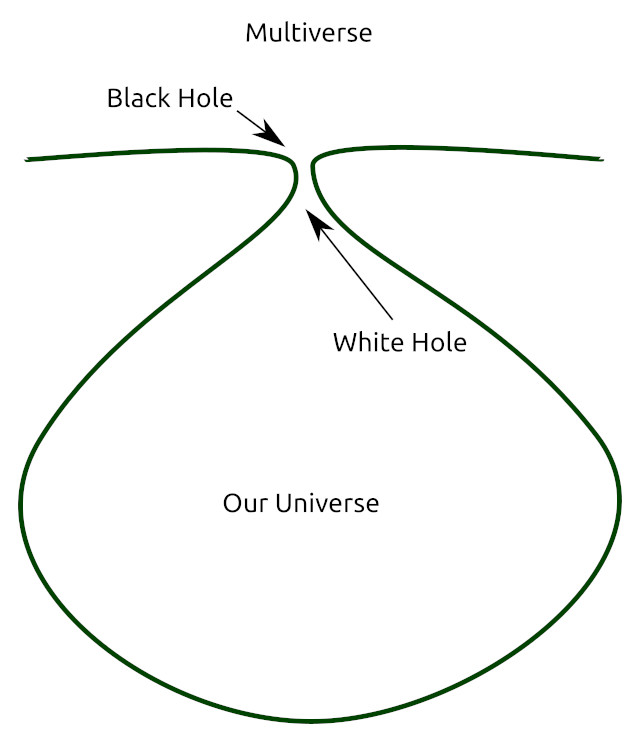
A black hole in the wider multiverse pinches off a "bubble" of spacetime. The Big Bang is then the "white hole" on the other side, where it all seemingly came from, when you're inside the pinched-off "bubble" that is our universe. And this can even explain the expansion of the universe, as it's just more being pinched off from the multiverse and so the "bubble" inside is getting bigger.
I guess the physical way you'd visualise this is that you get a waterproof stretched sheet, and then start filling it with water. Now, if we did that with a stretched sheet, the mouth would just get bigger.
So imagine we get a ring, underneath the sheet and we push the sheet through the ring, then we start filling it up with water. The ring would now be stopping the mouth getting bigger. But, as we add more water, the bulge underneath - our pinched off "bubble universe" - would be getting bigger. Like filling up a water balloon.
So, you've got an elastic sheet. That's spacetime. Then you put a ball on that sheet, which bends it, and that's "the Sun" warping spacetime. But then you put in a really heavy weight, and that's a "black hole", which is distorting spacetime extremely drastically (indeed, so much so, that if you really were doing this with an elastic sheet, it's too much weight and the elastic sheet would be stretched too far and break).
Now, to make our visualisation work better, we go underneath and we put a ring under the sheet. Because if we really did put a stupidly heavy weight on the elastic sheet, the "mouth" would just get bigger and it wouldn't look like "the pit" we see in the second diagram.
So, actually, to simulate the "black hole", we're going to get a ring and then put the heavy weight through the ring. But the ring will stop the mouth getting bigger. And then it would actually look a bit more like that diagram, with a really deep "pit", with steep walls (and the near-vertical steepness of those walls can be seen as the "event horizon" of the black hole - the sides are just too steep that nothing, not even light, can get enough speed to climb back out of this "pit").
Then, to complete our visualisation, we get a hose and start filling it up with water. Because of the ring we installed, the "mouth" of our black hole won't get bigger, but the bulge underneath - our pinched-off "bubble universe" - will start filling up, like a water balloon. Getting bigger and bigger. And that's, in this model, the expansion of the universe.
And so, looking at my crude little diagram, you can see that we're inside the black hole. The universe is a black hole. It's the pinched-off "bulge" - we pinched it off with that ring and then putting the heavy weight of more and more water through the "mouth". And as more water (energy) falls into the hole from the "multiverse" side, the "universe" bulge underneath gets bigger, which is the universe expanding.
And, yes, in this model, it's perfectly possible that the black holes we see in our universe are doing the same thing. Pinching off a bubble, on the bubble itself. Something like this:
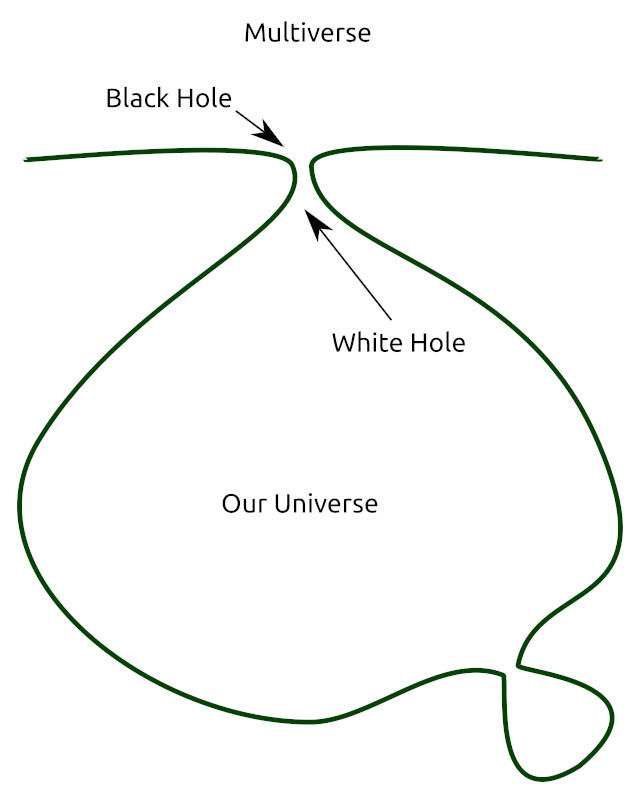
And, yeah, there's a "turtles all the way down" in that. I've labelled it "the multiverse" but is the universe from which our universe is "pinched off", actually itself pinched off from an even bigger universe? And are black holes in our universe pinching off other universes "below" us?
How far up does this go? How far down does this go? Is it just turtles all the way in both directions?
Or is there actually a limit to it - a "mother" universe at the top, and there's only so many times you can "pinch off" because there's some property that actually differs from universe-to-universe, and with every "pinch off" there's something that's actually running out (energy? available spacetime?) that stops it going on forever. If there is such a property, then different "levels" of universe would actually be, in some way, physically different.
As I say, this is an old idea. It's kind of - as the "plastic sheet" explanation I've given shows - a somewhat intuitive way to look at things. Almost a natural extension of General Relativity, once you pull out the "plastic sheet" analogy. You can just "pinch off" a bit of the plastic sheet. And then what's logically to stop you from pinching off another smaller bulge from that?
But the grand problem - why this idea went out of fashion - is that you'll notice that in my diagram, I'm not fulling pinching it off. I'm not putting a singularity in there. But, ah, if there really is a genuine singularity there, then how do you physically get past it.
To bring back the diagram from above, you'll notice that they're drawn it with a point - the singularity - in the middle:
And that's the big downer for this idea. If it really is all being pinched off to a mathematical singularity, then nothing passes. The "mouth" closes up completely. There is no way for anything to pass through to some "pinched off" universe on "the other side". Indeed, if there is a mathematical singularity at the bottom of our pit then, simply, there is no "other side".
But, ah, this is based on Einstein's geometric interpretation. Which doesn't include quantum mechanics. In Einstein's maths, distances can go all the way down to zero. But, in quantum theory, the concept of "distance" stops applying / making sense below the Planck length. So, if that's how it actually works, then you can't actually have a genuine mathematical singularity.
So maybe quantum mechanics / string theory can actually let things "pass through a singularity" - because, ah, it's not really a singularity in the mathematical sense. There's a Planck length "ring", under the plastic sheet of spacetime, stopping the "mouth" closing up completely. It's tiny - Planck length in size - so nothing is passing through intact to convey any useful information. But if there's that tiny "pin prick" of a hole in the sheet, stuff could pass through and start filling up "the water balloon" on the other side.
I'm not a physicist. And I have no idea what's actually correct. But it's a cool theory.
(p.s. In my personal "head canon", that's how the TARDIS works.
The inside of the TARDIS is its own pinched off "bubble universe". That's how it's bigger on the inside than the outside. Because, on the outside, all you're seeing is the "mouth". When the TARDIS travels through time and space, it's just moving this "mouth" to connect to the universe in different places. That the TARDIS is basically a "spacetime manipulator". It can pinch off spacetime to create a bubble universe for itself. It can move the "mouth" of the bubble universe to attach it to anywhere in wider spacetime. It can re-arrange its own internal spacetime - and move rooms around.
This is also how the TARDIS is basically invulnerable. Because you literally cannot get from the outside to the inside - or vice versa - except through the door (which is really the mouth of a wormhole, but the TARDIS can manipulate its shape into looking like anything it likes. Which is also how it can disguise itself to look like anything. It's not really a physical object - it's a distortion of spacetime that's made to look and behave as if it's a physical object to fool you.
It all fits. Well, except for that fucking RTD episode when "the Titanic" broke through the fucking side of the TARDIS wall. That would be impossible by the "pinched off universe" idea. Oh dear, I'm going to start getting "nerd angry" at RTD again, when he takes over, aren't I? Never mind, it's vastly better than Chris fucking Chibnall. All is forgiven, RTD. Even breaking my TARDIS head canon.)
"Words ought to be a little wild - for they are assaults of thought on the unthinking."
- John Maynard Keynes


