

To be clear, the right wing put up taxes. it's a simplistic electioneering myth that "socialism" means putting up taxes, to be relieved by the next conservative government.zip accident wrote:I'm not convinced that they didn't put up taxes
Look at the actual figures, from the OBR here, to see the truth of the matter:
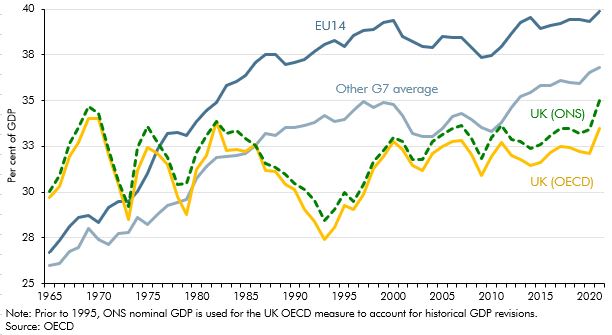
Yes, Maggie (from 1979 to 1990) dropped taxes. But look at that initial steep incline at the start of her reign. She filled up her coffers first, to be able to afford to give it away. Really, though she did end up with the lowest tax burden so far, most of her reign was not that radically different - within the same range - as anything previous.
The tax burden rose again under Major. There's a little electioneering "glitch" in there, where it drops just before the election of Blair. it goes up under Blair and Brown - but draw the horiztonal line, as it never gets worse than Maggie's peak - and then the most recent run of Tories kept it high, before a spike - just before Starmer took over (he's not on this graph, as it ends 2022) - to the highest recorded tax burden ever. Under the Tories.
As we're also talking America here, then we can see that it's an even greater myth in the land of the free:
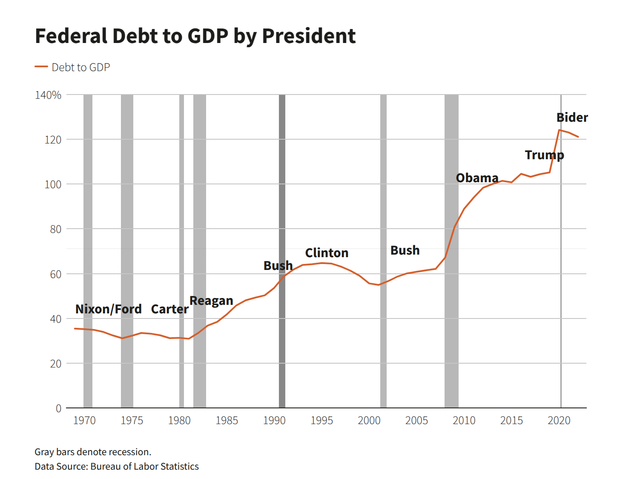
This is the US national debt with the presidential terms marked on it for context. Reagan sent it soaring upwards. Bush senior kept it going. It was the Democrat, Bill Clinton, who levelled it out and started reversing it. Then it started rising again under Bush junior until a spike just before Obama took over. Who, you'll note, levelled it off - admittedly, he didn't lower it but he avoided it getting worse.
Then we reach Trump's first term, with an insane near-vertical increase (although, in fairness, he did face the Covid pandemic that did no favours for the national debts of any country on Earth). Until Biden can be seen attempting to modestly decline it again, but he only had one term. Trump's back. Let's see if his DOGE actually does a single sodding thing to shift the needle. Because, by track record, he's the worst President on this graph for ramping up government spending, in fact.
Like, with the British graph, we can see left and right both raising and lowering the tax burden. It's a more mixed picture. But the American graph betrays the actual truth - Republicans increase the debt, Democrats at least try to bring it under control, if not lower it.
It's a real simplistic notion that "socialists" put up the taxes and the bills, while conservatives relieve it all. It's great electioneering, that both sides are guilty of pandering to, as the rich want to hear "tax breaks" and the poor want to hear "tax the rich".
But what actually happens in practice is not remotely what the election "mythology" would have us believe.
Truth is, the NHS saves us a ton of money.
Look to the dysfunctional American healthcare system. It's the most expensive healthcare system, per head, on planet Earth. And they don't even get to be top of the medical outcomes for that price either - American health outcomes are about middling in the international tables. They pay vastly too much for only middling healthcare.
The NHS is cheaper, because every taxpayer is part of the "National Insurance" scheme. The more people on an insurance scheme, the lower the premiums - as you amortise the risk. Plus, the government runs it not-for-profit, so the costs are lower.
Heck, I understand why we can't do it. Because if we disregarded patent law for the NHS, then Big Pharma would stop dealing with the UK and we'd miss out on the latest medicines. But, ah, to get a patent, you have to publish the details. The temptation would be for the NHS to ignore patent law and just produce generic medicines itself. Then our NHS bill would plummet overnight. Fuck the patents on the MRI machine, the government has the resources to produce its own.
But we don't do it, because you would make vengeful enemies of these corporations and they do, you know, come up with good medicines and medical equipment that we need. So we're obliged to respect their patents and their extortionate profiteering prices, unfortunately.
But a true "socialism" - that gave no fucks - would bring the medical bill right down, even further still.
A straight line is not always the shortest path. Indeed, what frustrates me about Starmer right now is that he should simply fuck the "borrowing rules". Take out a chunk of national debt and then plough it into restoring the national infrastructure. Keynesian economics.
Bad national debt is borrowing just to pay the bills. This is, indeed, like taking out a new credit card to pay off your previous credit card bill. It's a vicious circle that you never want to get into.
But increasing national debt to pay for improved infrastructure, to raise the capacity of the country, so that it can recover and expand and grow is THE legitimate reason why governments have borrowing powers in the first place.
And we really need to pump the capacity back up, as 14 years of the Tory "austerity" has drained it to near collapse.
There's proof that Keynesian economics works. Because it was practised in the post-war period - to rebuild Europe - and it resulted in the historic aberration of a few decades of ordinary people being able to comfortably buy their own homes and each generation doing better than the last. So good, that even with Maggie and Reagan's reversal of these policies, it still took decades to truly empty out the bank and leave us with no capacity.
What do I mean by capacity?
I mostly work from home, but when I go into the office, I commute by bus. The word "capacity" is literally written up there, near the door, and tells you the seated and standing capacity of the bus.
The bus I take used to run every half hour. But due to Covid and the cost of living crisis, they've dropped it to every hour. Your standard "tighten our belts" austere policy of reducing costs. Fair enough.
But the thing is, pretty much everyone on that bus uses the "zone pass". Travel wherever you like within "the zone" for a flat fee. And pretty much everyone's got that, because if you're travelling more than about 4 or 5 stops, it ends up costing the same as the "zone pass" and the driver even tells you this: "look, mate, if you're going that far, then you might as well get a zone pass. Costs a fiver and then you can use any bus in the zone, all day long, for the day". There are weekly and monthly zone passes, with a suitable discount.
The commuter busses - the couple before 9am and from 5:30 in the other direction - are always packed. Often I've got to stand initially, until a few people have gotten off, for me to get a seat. It reaches seated capacity easily and sometimes threatens the standing capacity as well.
Because of the fixed fee "zone pass", we can simplify this as saying that, yes, they've reduced their costs by running half the buses, but - for the commuter buses - they've also reduced their capacity - their maximum income - by half as well.
And they literally did the reduction in the most brain-dead manner, as they just got rid of every other bus. Rather than keeping the commuter buses - that are always packed to capacity - and then dropping, say, the 11am bus that nobody takes (I have taken the same bus during the day, when I was on jury service and, yes, the amount of people using it outside commuting does drop a lot - that's the bus that you nix, in order to keep half hour buses for the commuting hours).
Of course, if you have to tighten the belt, then you have to tighten the belt. But it should be approached with apprehension, as you're also reducing your capacity. Your ability to recover and get back on your feet. Your ability to grow in future.
Tory "austerity" gutted out the country's capacity - and our ability to recover - but yet it did not do what was intended.
You've heard of "the definition of madness", yes? That is, to perform the same action repeatedly, yet expect differing results.
We "tightened the belt" for 14 years. What did this accomplish? We kept doing it again and again. Tighten the belt, tighten the belt. But all we did was cut off our capacity to even breathe... and what was fixed by doing so? Nothing. As we're still sitting neck-deep in the shit to this very day.
The proof positive is right there. We did suffer over a decade of austerity. Did it help the economy recover? No. So why continuing to do it - for 14 fucking years - produce any differing results? Well, it wouldn't. Because it literally didn't.
You can have as much "theory" about how the economy works as you like. But if you do the thing, and the results do not show up, then that theory IS WRONG.
Similarly, if the "trickle down effect" worked, then there wouldn't be an ever-widening gap between the rich and poor. The "trickle down effect" is supposed to fix things and restore financial equality, right? But we did that - we've been doing it for decades upon decades - and it doesn't work. The gulf between the rich and poor is ever-widening at any ever-increasing rate. It just doesn't work. Because you can say "X does this" but if you have X and it doesn't, in fact, happen, then that statement is simply wrong.
(In fairness, I don't actually doubt that the trickle down effect is real. I just think it's ridiculously inadequate and insufficient to have the desired effect. Yes, when a billionaire buys a fast car or a mansion, then they are paying people to do it, so that money goes back into the economy. But the price of one supercar or mansion does absolutely fuck all to the overall picture. Of course not, because even if that supercar cost a million dollars, then what's a million in the midst of an economy of trillions upon trillions? Fuck all. So unsurprisingly has no useful effect on redistributing wealth.)
Indeed, this is somewhat by definition. For someone to be a "billionaire", this means that they have amassed at least a billion of whatever currency.
But money only has value when it's spent. it's just an "I.O.U. £20, signed the Bank of England" note with Charlie's face on it, until it's exchanged for something with actual practical worth.
Billionaires and millionaires are locking up money. Hording it, which keeps it out of the economy. Rich people are not good for an economy, they are a massive drag on it.
Imagine a circle of people. I'm one of those people and I have a £5 note. I hand it to the person on my left, and in exchange they give me some food. That person hands the £5 note to the person their left - their supplier - and buys the food that they sold to me. And so forth.
We hand the £5 note around the circle. With each exchange, we buy something - something that's actually valuable to us, such as food or clothes or heating or entertainment. And around and around the £5 note goes. Until eventually it returns to me and I can buy another thing.
Now, imagine that exchange happening faster and faster and faster. The £5 note travels around in a blur, it's going so fast. And this means that 0.1 seconds after it left my hand, it's back again.
There is only one £5 note in this scenario. But the faster the process goes, the sooner the £5 note comes back to us. And it's almost like we all "virtually" have a £5 note each.
Compare it to multi-tasking on a single core CPU. The CPU is, in fact, only doing a single task at any one time. But it rapidly changes tasks so quickly, that it appears like it's doing multiple things at the same time. It isn't. But the rapidity of it all gives this "virtual" illusion that all tasks are being processed simultaneously.
Right, let's stick a billionaire in the circle. The £5 note goes around, reaches the billionaire and they pocket it. Because they horde money. That's what they do - that's how they've got more than 1 billion quid in their bank account.
But, as I say, they're a block on trade. And it's trade - moving the £5 note around the circle - that actually makes us all wealthy.
Having more and more billionaires, sitting on vast piles of cash, is actually slowing down and blocking that trade. It's stopping it going around the big economic circle.
Sure, eventually Elon will spunk $44 biillion on Twitter or something, and big lump of cash enters the circle again. Excellent. But then all the billionaires just keep hording it again. There's a small burst of trade, but then it all locks back up again.
We need trade, not vast wealth. Now, capitalism is all about building up - hording - a big chunk of cash, because some things require a big slab of money to get done. We do need some capital, but we need trade more for a healthy economy.
(Also, the institutions in charge of the biggest blocks of capital are governments, in fact. They deal in the league of trillions, whereas the richest man in the world is only worth hundreds of billions. Quite literally, Elon's the richest man in the world. But SpaceX is totally paid for by the taxpayer. Indeed, this idea that privatising the space industry will reduce taxes... well, eventually it might, when SpaceX is more about commercial flights and space tourism and stuff. But, right now, it's pretty exclusively NASA and the American taxpayer - wanting them to deliver people and cargo to the ISS - who are their only customers. I don't disapprove of the trajectory here, but just pointing out that just making it a private company doesn't itself mean the taxpayer pays less, if the only customer of the private company is the taxpayer.)
As I've suggested before, there really is no fundamental difference between "the State owns everything" (Communism) and "Elon Musk / Bill Gates / Rupert Murdoch owns everything" (monopolistic capitalism). Because who gives a fuck who the tyrant is, when you're living under a tyranny?
Because, to be clear, I'm neither the Marxist "left" nor "right" here. I'm actually a classical liberal. The entire problem with Marx, for me, is that he comes right out of the gate with contradictory false dichotomies.
"All men are equal" but yet, at the same time, "there are two types of people - the rich and the poor - and they need to be in class warfare with each other". It's either one or the other, Marx, it can't be both.
And there's a massive problem with the end result. So the Proletariat succeed, and they own the means of production. So now they collectively own the factory, and the factory does well, making lots of money.
Wait a minute, now they're the self-employed business owners of a private enterprise that's raking in the cash. Aren't they now just the new Bourgeoisie?
And now the new Proletariat is the young people. They weren't there when the factory was taken over, so they don't collectively own it. And, of course, under Marxism, we would not have something so vulgar as inherited wealth, right?
So, if you take this to its logical conclusion, we have the younger generation fighting the older generation to take the means of production from them, creating a new Bourgeoisie for the Proletariat to fight. Again and again and again. "The King is dead; Long live the King".
Think about it. In the traditional Marxist narrative, they never go this far. It's all about the poor fighting the rich in class warfare. But there's no discussion of the conclusion should they succeed. Indeed, it's almost like Marx reckons it'll never succeed, as there is no plan given beyond just "fight the rich". And, as I say, if you do imagine that the poor succeed, then they will be securing their financial future... and become prosperous. They become the new rich. What then? Just hold onto your wealth - like the rich before you did - as the new poor come and attack you?
This is a nonsense. It's a never-ending cycle with no conclusion. No stable state.
An actual solution to this problem has to have universal applicability. To everyone. Rich and poor alike. Otherwise, it can never reach a stable state.
So, sure, though I am obviously left-leaning - that is, I have the greater sympathy for the Marxist left's goals because they are trying to make it fairer for the most people - I'm neither left nor right, by the Marxist definition, as I actually seek a solution that makes it fairer for absolutely everyone. The rich included. Because we will have rich people. When someone succeeds well, they're going to end up with a greater share of the pie from their success. The trick is translating this into being of benefit to all of us at the same time.
Adam Smith was aware of this and proposed a "rising tide raises all ships" model. Because it's the cruel libel upon him that he ever remotely said "greed is good". Actually, his recommendation was philanthropy.
If you look in your local community, here in the UK, at the public libraries and parks, there's often a foundation stone on it that has something like "Donated by [local industrialist] to the local community". In the early Industrial Revolution, many industrialists actually followed Smith's plan and that's why these local community facilities exist.
Here's the plan. I'm a rich industrialist and I make a ton of cash from employing the local people in my factory. So I take a chunk of that cash and I buy the local community a library - so they get educated and knowledgeable - and a local park - so they can exercise and relax in nature - and a local community centre - where there are adult education lessons.
Because I'm looking after my workers this way, they get more educated and become more productive and inventive workers for me. They can remain fit through exercise, so I get less people calling in sick. They are less stressed out, so I get less people calling in sick or being lost to burn out. They're also loyal workers for me, because I'm actually looking out for them. I genuinely give a shit to improve their lives, where I can.
So I have much more productive and engaged workers. We all make more money in the factory. And, again, I take a chunk of that money to philanthropically invest in the local community.
This is Smith's model. That's how self-interest can become "enlightened" and help everyone out. That a rising tide can raise all ships, if we just pump some of that water back down to the bottom of the pyramid again. Then we can raise the whole pyramid up.
Mind you, there are valid criticisms of Adam Smith. This is a Hollywood movie, so it's hardly a rigorous examination or remotely historically accurate, but it does get across - in a simple way that everyone can understand - how, as I like to say, "a straight line is not always the shortest route".
Enlightened self-interest. Helping out the group you're in, helps you out too. Because you're in that group. If you like, you need to optimise both your individual self-interest AND your group self-interest too.
But, yeah, the tribal "left" and "right" is bollocks. It's all built on false dichotomies. It pits "society" against "the individual", but societies are composed of individuals. They are one and the same, at different levels of abstraction. To attack society for the sake of the individual harms the individual because they are a part of that society. To attack the individual for the sake of society harms society because "society" is a collection of individuals.
It's like chopping your hand off to "free" it from the tyranny of the arm, failing to realise that, without the arm and the rest of the body, the hand dies.


