SPACE

Inane baanter or words of wisdom - you decide...
Post Reply
User avatar
zip accident
Sheepie Whore
Sheepie Whore
Posts: 13928
Joined: Sun Feb 20, 2005 1:58 pm 0
Location: Bristol, UK

Re: SPACE

Post by zip accident »

pogo wrote:
benedictw wrote:Asteroid mining, I don't expect that to be cheap nor quick - so expect some heavy investment from the billionaires funding this.
The key will be to identify a target which makes it worthwhile. E.g. there are many elements on Earth that are very valuable because they are rare and/or hard to get to, and we're finding more and more uses for such rare elements. Asteroids won't have the same distribution of elements as Earth, and won't have experienced 4+ billion years of geological processes dispersing and burying elements that we have.

There are half a million (and growing) that we know of. Even if 99.9% (so the first thousand) are uninteresting there could be hundreds that are incredibly valuable and well worth retrieving. The problem of course is identifying them.
Nah.

The problem is getting stuff up there from here.

So stuff that doesn't apply to, is intrinsically much cheaper. The price of diamonds wouldn't make asteroid mining economic if Earth was the target (diamonds bigger than we can make or find excepted), but when space is the target then anything that's cheaper than bringing it up through one "g" is worthwhile.
"My way is the way of not fighting":- the book of Enter the Dragon.
User avatar
pogo
Sheepie Whore
Sheepie Whore
Posts: 14180
Joined: Tue Sep 10, 2002 8:28 pm 0
Yahoo Messenger: BrassSparrow
Location: County Durham

Re: SPACE

Post by pogo »

It's a problem that can be solved by money and the investment might be justified if someone finds an asteroid full of gold, or diamond, or uranium. The problem is so far we've mostly got guesses based on surface spectra, and probably few of those. This gives us some indication but a reasonable sized asteroid could contain significant amounts of anything and you wouldn't know. We might get lucky and spot the glint/spectra of something valuable but we might need to actually get close or even out there to have a look.

A manned mission to the Asteroid belt one day might make sense. It would be cheaper than going to Mars as it's not much further and you don't need to include a large rocket with fuel to escape Mars's gravitational field on the way back. That's still not cheap but as the next least expensive to send people after the moon we might do it one day. Or a large probe that's able to do science on many asteroids and spends many years in the belt.
User avatar
Dio
Sheepie Whore
Sheepie Whore
Posts: 18887
Joined: Mon May 31, 2004 1:08 pm 0
Location: Newcastle UK

Re: SPACE

Post by Dio »

Darkflame wrote:If we can do unmanned earth-to-orbit single stage craft, whats so hard about making it manned :?
Life support is very heavy, and the reliability requirements increase by a couple of orders of magnitude.
User avatar
Darkflame
Sheepie Whore
Sheepie Whore
Posts: 18236
Joined: Mon Mar 31, 2003 11:06 am 0
Location: Not the UK

Re: SPACE

Post by Darkflame »

What constitutes life support other then the oxygen tank? Couldn't it effectively be just wearing a spacesuit?
User avatar
Dio
Sheepie Whore
Sheepie Whore
Posts: 18887
Joined: Mon May 31, 2004 1:08 pm 0
Location: Newcastle UK

Re: SPACE

Post by Dio »

A pressurised container, oxygen, CO2 scrubbers, water, food, temperature control, light, somewhere to go to the toilet, airlocks unless you're trapped in your bubble. But more than that - just the physical space for people to exist in is heavy and restricts design.
User avatar
zip accident
Sheepie Whore
Sheepie Whore
Posts: 13928
Joined: Sun Feb 20, 2005 1:58 pm 0
Location: Bristol, UK

Re: SPACE

Post by zip accident »

pogo wrote:It's a problem that can be solved by money and the investment might be justified if someone finds an asteroid full of gold, or diamond, or uranium.
The cost of getting to orbit is huge. There's one online estimate of $10,000 per kg. That's $10 per gram. The odds of getting something down from space at less cost is low. Gold is apparently currently £12 for 9 carat purity, the orbital ore would need refining, the chances of it being pure enough to be profitable are very low in my opinion. That is entirely ignoring the fact that the price of gold depends on its rarity, if it were common stuff it would be cheap.
A manned mission to the Asteroid belt one day might make sense.
I don't think the plan would be to go to the belt for the asteroid, there are many in near Earth orbit, going to the belt eventually is fine, but we don't need to for this plan.
"My way is the way of not fighting":- the book of Enter the Dragon.
User avatar
pogo
Sheepie Whore
Sheepie Whore
Posts: 14180
Joined: Tue Sep 10, 2002 8:28 pm 0
Yahoo Messenger: BrassSparrow
Location: County Durham

Re: SPACE

Post by pogo »

zip accident wrote:
pogo wrote:It's a problem that can be solved by money and the investment might be justified if someone finds an asteroid full of gold, or diamond, or uranium.
The cost of getting to orbit is huge. There's one online estimate of $10,000 per kg. That's $10 per gram. The odds of getting something down from space at less cost is low. Gold is apparently currently £12 for 9 carat purity, the orbital ore would need refining, the chances of it being pure enough to be profitable are very low in my opinion. That is entirely ignoring the fact that the price of gold depends on its rarity, if it were common stuff it would be cheap.
The math doesn't apply for getting stuff back. Suppose a source of gold was found, 1000 tons of it say. You don't pay by the gram for blasting that into space, only for the rocket that goes to get it, which will weigh many times less. Stuff coming from the asteroid belt to the earth does so by falling into the Earth's gravity well and the Sun's. We need to slow it down but we already know how to do that (mostly) safely for squishy people and satellites, so I'm sure we can do it do it for rocks.

As for the economics it's true that a big find delivered quickly will depress prices. But it will take time to exploit any resource so the effect will be minimal. Also going forward the prices for many minerals will rise as demand grows and we run out of cheap and easy places to dig them out of the ground, so space-based mining may help maintain supply, not boost it. There may even be minerals that we don't use because they are too rare in Earth's crust, the discovery of which in space spurs new applications and technologies.
User avatar
zip accident
Sheepie Whore
Sheepie Whore
Posts: 13928
Joined: Sun Feb 20, 2005 1:58 pm 0
Location: Bristol, UK

Re: SPACE

Post by zip accident »

pogo wrote:
zip accident wrote:
pogo wrote:It's a problem that can be solved by money and the investment might be justified if someone finds an asteroid full of gold, or diamond, or uranium.
The cost of getting to orbit is huge. There's one online estimate of $10,000 per kg. That's $10 per gram. The odds of getting something down from space at less cost is low. Gold is apparently currently £12 for 9 carat purity, the orbital ore would need refining, the chances of it being pure enough to be profitable are very low in my opinion. That is entirely ignoring the fact that the price of gold depends on its rarity, if it were common stuff it would be cheap.
The math doesn't apply for getting stuff back. Suppose a source of gold was found, 1000 tons of it say. You don't pay by the gram for blasting that into space, only for the rocket that goes to get it, which will weigh many times less.
So you go and get it (and whatever does that pays the full cost to orbit), then you de-orbit it into, say, the Sahara. There is a very high chance of it going bang! on the way down. Suppose it makes it down in one piece, without losing much mass to ablation, who then owns it? The country it landed in has a pretty good claim.
"My way is the way of not fighting":- the book of Enter the Dragon.
User avatar
pogo
Sheepie Whore
Sheepie Whore
Posts: 14180
Joined: Tue Sep 10, 2002 8:28 pm 0
Yahoo Messenger: BrassSparrow
Location: County Durham

Re: SPACE

Post by pogo »

zip accident wrote:So you go and get it (and whatever does that pays the full cost to orbit), then you de-orbit it into say the Sahara. There is a very high chance of it going bang! on the way down. Suppose it makes it down in one piece, without losing much mass to ablation, who then owns it? The country it landed in has a pretty good claim.
It's a solved problem for e.g. people, excepting the accidents. For people you have two issues you don't have with rocks: people are squishy and they need life support which weighs many times them (and is also quite fragile). So it will be many times cheaper than bringing people back from space, something that's been done hundreds of times.

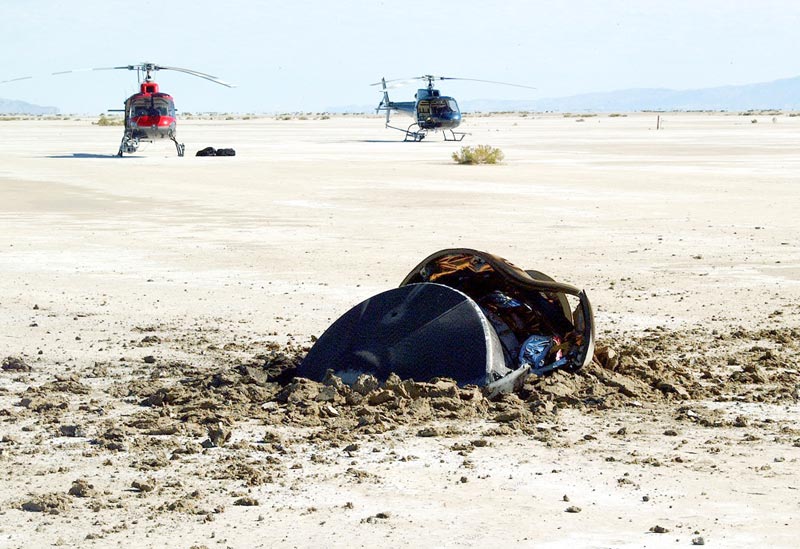
As for aiming strap a heat shield and small rockets, aim it at Earth and make small adjustments at the right point to ensure it comes down where you want. They managed it with the Genesis probe, which went much further than the moon. It crashed because it failed to deploy a parachute but again a rock has no need for a soft landing. A crash landing like Genesis's failed one would be fine:

Image
User avatar
Firefox
Sheepie Whore
Sheepie Whore
Posts: 11412
Joined: Fri Apr 26, 2002 6:15 pm 0
Location: Sheffield

Re: SPACE

Post by Firefox »

Would you even need that? Perhaps if you're deorbiting a big enough chunk of ore you can put up with a certain fraction of it ablating during re-entry?
"I am a very considerate person. If I want to go out all night on my miniature golf course and shoot lizards, well, no reason to keep the neighbours awake..."
User avatar
zip accident
Sheepie Whore
Sheepie Whore
Posts: 13928
Joined: Sun Feb 20, 2005 1:58 pm 0
Location: Bristol, UK

Re: SPACE

Post by zip accident »

Firefox wrote:Would you even need that? Perhaps if you're deorbiting a big enough chunk of ore you can put up with a certain fraction of it ablating during re-entry?
It's still a meteor. Do they lose 95% of mass on the way down? 75%? more? I don't know exactly, but I do know it's a lot.

The real point is, if it's something useful but cheap, like iron, then you don't have the cost of getting it up to orbit, and at $10k per kg, $10m per ton, that is a big win.
"My way is the way of not fighting":- the book of Enter the Dragon.
User avatar
pogo
Sheepie Whore
Sheepie Whore
Posts: 14180
Joined: Tue Sep 10, 2002 8:28 pm 0
Yahoo Messenger: BrassSparrow
Location: County Durham

Re: SPACE

Post by pogo »

zip accident wrote:
Firefox wrote:Would you even need that? Perhaps if you're deorbiting a big enough chunk of ore you can put up with a certain fraction of it ablating during re-entry?
It's still a meteor. Do they lose 95% of mass on the way down? 75%? more? I don't know exactly, but I do know it's a lot.
It will depend on their size: the small rocks that account for most meteors lose all their mass on the way down. But the larger things we bring back now lose 0% of their mass. All they need to do is dissipate heat, using e.g. a heat shield made of materials that can withstand high temperatures. In some cases the asteroid may come with the right sort of material, otherwise it will be blasted off into space much as it is now.
User avatar
zip accident
Sheepie Whore
Sheepie Whore
Posts: 13928
Joined: Sun Feb 20, 2005 1:58 pm 0
Location: Bristol, UK

Re: SPACE

Post by zip accident »

pogo wrote:It will depend on their size: the small rocks that account for most meteors lose all their mass on the way down. But the larger things we bring back now lose 0% of their mass.
Don't be silly. Nothing in life is perfect, 0.000000... % loss is not any more possible than perpetual motion. The shuttles' tiles needed to be replaced I'm sure, whether that was every mission or every five I don't know.
All they need to do is dissipate heat, using e.g. a heat shield made of materials that can withstand high temperatures. In some cases the asteroid may come with the right sort of material, otherwise it will be blasted off into space much as it is now.
Great, asbestosis for everyone. :( :wink:

Really, the heatshields we use are very specialised, and nothing like them is likely to occur naturally.

I'm not saying it can't be done, but the costs will be non-trivial. The shuttles could have brought stuff down, but with them having been mothballed, you'd need a specialised de-orbiter craft of some sort, and you'd have to get that up to orbit.

Smelting metals up there is a much better idea, but it won't be easy.


This however, I am pretty sure is not the way to do it:
zip accident wrote:
Bog wrote:

Heh, I was thinking in the shower this morning that nickel-iron asteroids, heated by solar mirrors and spun to centrifuge out impurities, would make a dandy "instant hull" just by sticking a needle into the melted metal and pumping in an inert gas.
Not entirely new.
Book "A Hole in Space" Larry Niven, Chapter "Bigger than Worlds" 1975

The next step up in size is the hollow planetoid. I got my design from a book of scientific speculation, Islands in Space by Dandrige M. Cole. and Donald W. Cox.

STEP ONE: Construct a giant solar mirror...

STEP TWO: Pick a planetoid. Ideally, we need an elongated chunk of nickel-iron, perhaps one mile in diameter and two miles long.

STEP THREE: Bore a hole down the long axis.
STEP FOUR:Charge the hole with tanks of water...
STEP FIVE: ... spinning slowly on it's axis... Gradually heated...

STEP SIX ... water tanks explode... ten miles in diameter and twenty miles long, if everybody has done their jobs right.
Which isn't identical, but is very close IMHO.

No offence intended, but we as a culture seem to be re-inventing everthing that isn't on the net, which is wasteful.

:D
Because it depends on molten metals and pressurised gases behaving predictably, and experience shows that sadly, they generally don't. Particularly, when making DIY lead sinkers for angling, you have to make sure that the mould is dry, because water in contact with molten lead will explode, note, it will explode, not it will blow a nice bubble which might burst, it will explode. I knew that before I wrote the above, but I suppose I was being optimistic, or not thinking things fully through. The problem I think is that water takes the path of least resistance, and so does a gas under pressure, so when some of the molten metal starts moving out of the way, the gas heads in that direction, which makes that bit of molten metal thinner, and less resistant than the rest, so more gas moves that way, so the metal gets weaker, so more gas moves that way, until the metal ruptures, and releases the gas, resulting in high speed hot metal everywhere (and the gas gone).
"My way is the way of not fighting":- the book of Enter the Dragon.
User avatar
pogo
Sheepie Whore
Sheepie Whore
Posts: 14180
Joined: Tue Sep 10, 2002 8:28 pm 0
Yahoo Messenger: BrassSparrow
Location: County Durham

Re: SPACE

Post by pogo »

zip accident wrote:Really, the heatshields we use are very specialised, and nothing like them is likely to occur naturally.
I was thinking: if there's a rock with gold (or whatever) in it but it's deep and surrounded by rock then the rock acts as its heat shield. Some of that burns away on the way down but all of what you want makes it to the earth's surface. Maybe you have enough choice that you can easily find an asteroid like this. Maybe you need to remove some rock (as if its too big it will be more expensive to push towards earth), maybe add some shielding. But probably all asteroids will come with some rock which can do at least part of the job of getting it to Earth.

(although if explorers find asteroids that are pure gold, or uranium, or diamond, I doubt they will be too disappointed that they have to wrap them carefully).
User avatar
Darkflame
Sheepie Whore
Sheepie Whore
Posts: 18236
Joined: Mon Mar 31, 2003 11:06 am 0
Location: Not the UK

Re: SPACE

Post by Darkflame »

Dio wrote:A pressurised container, oxygen, CO2 scrubbers, water, food, temperature control, light, somewhere to go to the toilet, airlocks unless you're trapped in your bubble. But more than that - just the physical space for people to exist in is heavy and restricts design.
whahu? Why do you need all that stuff just to get up there?
I thought they just went in their suits in the worst case, and were told to go before they left anyway.
Ditto for food,water etc.
If your just using a craft as a way to a orbital station, it doesn't need all that stuff.

Light is trivial.
Guess heat control is a point though.
So you go and get it (and whatever does that pays the full cost to orbit), then you de-orbit it into, say, the Sahara. There is a very high chance of it going bang! on the way down. Suppose it makes it down in one piece,
Does it have to be in one piece? If your just after elements at the end of the day, even scattering a large quantity of rare materials over a area could still be usefull in large enough quantities to compensate for the collection expensive.
Post Reply