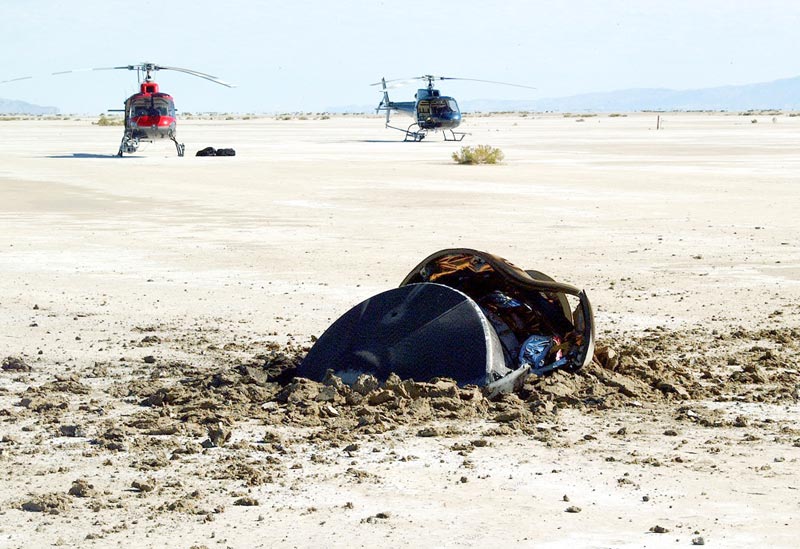
pogo wrote:It will depend on their size: the small rocks that account for most meteors lose all their mass on the way down. But the larger things we bring back now lose 0% of their mass.
Don't be silly. Nothing in life is perfect, 0.000000... % loss is not any more possible than perpetual motion. The shuttles' tiles needed to be replaced I'm sure, whether that was every mission or every five I don't know.
All they need to do is dissipate heat, using e.g. a heat shield made of materials that can withstand high temperatures. In some cases the asteroid may come with the right sort of material, otherwise it will be blasted off into space much as it is now.
Great, asbestosis for everyone.


Really, the heatshields we use are very specialised, and nothing like them is likely to occur naturally.
I'm not saying it can't be done, but the costs will be non-trivial. The shuttles could have brought stuff down, but with them having been mothballed, you'd need a specialised de-orbiter craft of some sort, and you'd have to get that up to orbit.
Smelting metals up there is a much better idea, but it won't be easy.
This however, I am pretty sure is not the way to do it:
zip accident wrote:Bog wrote:
Heh, I was thinking in the shower this morning that nickel-iron asteroids, heated by solar mirrors and spun to centrifuge out impurities, would make a dandy "instant hull" just by sticking a needle into the melted metal and pumping in an inert gas.
Not entirely new.
Book "A Hole in Space" Larry Niven, Chapter "Bigger than Worlds" 1975
The next step up in size is the hollow planetoid. I got my design from a book of scientific speculation, Islands in Space by Dandrige M. Cole. and Donald W. Cox.
STEP ONE: Construct a giant solar mirror...
STEP TWO: Pick a planetoid. Ideally, we need an elongated chunk of nickel-iron, perhaps one mile in diameter and two miles long.
STEP THREE: Bore a hole down the long axis.
STEP FOUR:Charge the hole with tanks of water...
STEP FIVE: ... spinning slowly on it's axis... Gradually heated...
STEP SIX ... water tanks explode... ten miles in diameter and twenty miles long, if everybody has done their jobs right.
Which isn't identical, but is very close IMHO.
No offence intended, but we as a culture seem to be re-inventing everthing that isn't on the net, which is wasteful.

Because it depends on molten metals and pressurised gases behaving predictably, and experience shows that sadly, they generally don't. Particularly, when making DIY lead sinkers for angling, you have to make sure that the mould is dry, because water in contact with molten lead will explode, note, it will explode, not it will blow a nice bubble which might burst, it will explode. I knew that before I wrote the above, but I suppose I was being optimistic, or not thinking things fully through. The problem I think is that water takes the path of least resistance, and so does a gas under pressure, so when some of the molten metal starts moving out of the way, the gas heads in that direction, which makes that bit of molten metal thinner, and less resistant than the rest, so more gas moves that way, so the metal gets weaker, so more gas moves that way, until the metal ruptures, and releases the gas, resulting in high speed hot metal everywhere (and the gas gone).
"My way is the way of not fighting":- the book of Enter the Dragon.