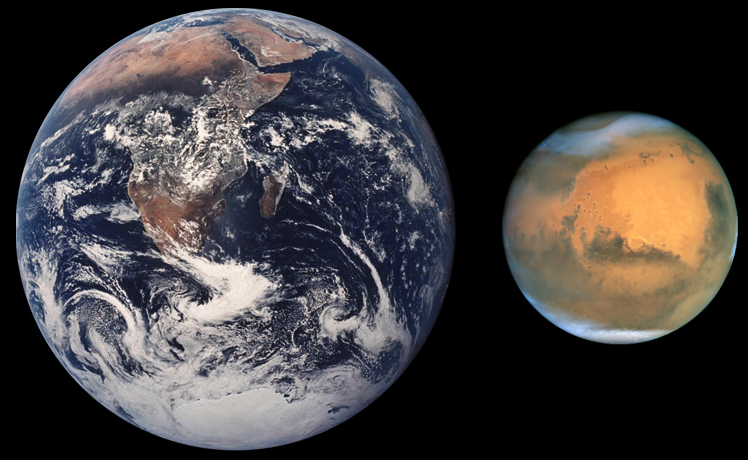
zip accident wrote:Mass: 0.107 Earths (nearer a tenth than a ninth).
Oops, nearer a ninth (which is 0.111 recurring).
Not even the moons of Jupiter or Saturn are big enough to have enough gravity to have an atmosphere.
Should be "a human breathable atmosphere".
pogo wrote:None of these places have an atmosphere we can use, so wherever you go you'll live indoors, or go outside only in spacesuits. This works for you in one way though: a vacuum is an excellent insulator. So on Mars where its cold keeping warm would be relatively straightforward. In fact you'd probably have to take care not to get too warm: if you used the sun for warmth and light it would be like living in a greenhouse without anywhere for the heat to escape. On Mercury where it's hot as long as you keep out of the Sun, so live e.g. in the shade, the lack of atmosphere would similarly help insulate you.
Mars has an atmosphere, it's not breathable but it's not a vacuum. There is a problem with Mars, it has enough gravity to make getting off again difficult, so it would be a one way trip. I wouldn't have a problem with it being a one way trip if living on Mars were going to be problem free, but it probably won't be, and there's no escape if/when something goes wrong. If we go to Mars as a one way trip I estimate the life expectancy of the explorers at one or two years, and that's not long enough.
Venus is another matter altogether. Not only is it much hotter but much denser, which would work the opposite way and cook anything down there very quickly. You'd need protecting against the pressure and heat, as well as maybe the chemical effects of the atmosphere. It would be difficult to move and see, more like working at the bottom of the ocean. Of course we're very familiar with doing that but on Earth with bulky equipment supported from a ship or platform.
Terraforming it so it's more like Earth would be impossible: the cost is quite inconceivable. Somehow you'd have to remove most of the atmosphere and it has many times as much of that as Earth. Think of all we're doing here, pumping CO2 into the atmosphere, as a side effect of almost all of our energy consumption (so we could not do more of it if we tried). CO2 in the air has risen by about 100 parts per million, so 0.01%. Now imagine removing (to where?) all the CO2 on Venus, about a million times as much as the CO2 here.
The main problem is the heat, a sun shade could fix that, there is a
Lagrange point directly sunward of any planet so the shade could sit there, if it was of low mass, which we would want it to be for cost reasons it would have to be used as a sail to keep it there, but I believe that's possible. If the heat were fixed we could drop in water, plant seeds, and soil worms, then more complex organisms as time went on. Plants would love the CO2 as I've said before. Comets are mostly water I think, so a few of those might do it. We'd need to be sure there was no life there already of course, but if not then I can't see a problem with dropping comets on Venus.
 http://ga.water.usgs.gov/edu/earthhowmuch.html
We don't need all of the large sphere, that includes the oceans, we would only need the fresh water sphere, though the oceans would be nice if we could find that much.
There would be some water present in the clouds of H2SO4 I don't know what would happen to that when the temperature dropped, it might come down as acid rain, that would be difficult to deal with, but the dissociation of the CO2 into carbon and oxygen would mean that the H2SO4 would probably be reduced. All of that would need to happen before we sent people. It wouldn't be a quick process, but compared to making Mars comfortable, in a longer term view it's much more plausible.
As for the Moon we've already been and brought back material. There's little I think of interest there: it's sterile, formed from the same material as Earth, and as a platform for e.g. further exploration or a source of materials is of little use because of the extra cost of launching from there.
We know we can launch from the Moon, so it's not a one way trip even at this point in time. It's not for the benefits of going there itself (they might not be totally null) that we should go, but as a step on the way to going further, you have to learn to walk before you can run, and we can safely go to the Moon.
Darkflame wrote:On mars you'd live underground I think.
Anywhere other than a terraformed Venus, that's pretty much a given.
Also, pretty sure water has been confirmed to still exist on mars in ice form. Probably dirty of course.
Still, easier to melt and clean then it is to bring it with us.
So you'd probably want a base near enough to a polar region to pump that water to you.
Water is also allegedly present on the Moon.
I think you'd also try to genetically engineer some plants to live in the Martian soil, rather then relay totally on greenhouses.
There's no liquid water. It's too cold. Any oxygen they produce in the martian atmosphere will be lost to space due to the low gravity.
"My way is the way of not fighting":- the book of Enter the Dragon.