stupid physics questions

Inane baanter or words of wisdom - you decide...
Post Reply
User avatar
zip accident
Sheepie Whore
Sheepie Whore
Posts: 13928
Joined: Sun Feb 20, 2005 1:58 pm 0
Location: Bristol, UK

Re: stupid physics questions

Post by zip accident »

Um ...

Image

http://www.gocomics.com/calvinandhobbes/

Right, wrong (or at least, there is a lot of hope that there will be post humans to follow after us, so our line won't go extinct (if chickens are direct decendants of T Rex, allegedly closer than Stegasaurus or Triceratops, but direct is sort of unknown I think, then T Rex didn't die out utterly)), right (but by then we'll have migrated, right?), and maybe wrong (it's kind of unknown, and there may be ways to to get into the next cycle if there is one).
"My way is the way of not fighting":- the book of Enter the Dragon.
User avatar
pogo
Sheepie Whore
Sheepie Whore
Posts: 14180
Joined: Tue Sep 10, 2002 8:28 pm 0
Yahoo Messenger: BrassSparrow
Location: County Durham

Re: stupid physics questions

Post by pogo »

Taking the long view we're all doomed as the universe will eventually get cold and die. That's going to take a very long time to happen though. E.g. many, many times longer than the lifetime of the Sun which is a more immediate problem. In a few (5?) billion years time the Sun will become a red giant and get hotter and bigger, so much so it will wipe out life on Earth. By then we will have had to solve the problem of getting off our planet.

Even that though is implausibly far in the future. We've only been civilised for a few thousand years. We've only been human for a million years at most. So who knows what we'll be like in another few thousand, or a million, years time. Think back 100+ years to how hard it was to predict the present day (or how laughably wrong predictions were). It's impossible to guess now what the future holds for us, or even if we'll be around to see it.
User avatar
zip accident
Sheepie Whore
Sheepie Whore
Posts: 13928
Joined: Sun Feb 20, 2005 1:58 pm 0
Location: Bristol, UK

Re: stupid physics questions

Post by zip accident »

pogo wrote: We've only been civilised for a few thousand years.
Exactly.

There's every chance we will be off the Earth far enough when the Sun goes bonkers to survive that. Colonies on the moons of Jupiter would do it, and in a billion years, if we don't destroy ourselves on Earth, that's pretty much a certainty. If we do destroy ourselves on Earth before leaving it in significant numbers (a viable population is minimally hundreds), then the chances are that in billions of years eucaryote life will evolve intelligence again, and leave Earth.

The biggest threat is Earthbound politicians wanting to destroy what they can't intimately control.
"My way is the way of not fighting":- the book of Enter the Dragon.
User avatar
pogo
Sheepie Whore
Sheepie Whore
Posts: 14180
Joined: Tue Sep 10, 2002 8:28 pm 0
Yahoo Messenger: BrassSparrow
Location: County Durham

Re: stupid physics questions

Post by pogo »

As I think was discussed in the Space thread the problem with leaving Earth is a pretty fundamental one of physics: it would require impossible amounts of energy to send up significant numbers, to say nothing of all the things they need to build a new life. We've been doing it for fifty years but it's not got any cheaper. In terms of escaping the Earth we've done very little: almost all trips have been to low Earth orbit except for those to the moon which sent a small team with just enough to survive for a few days (a few hours on the moon).

Current state of the art seems to be speculating about sending men to Mars. 'Speculating' because there are no firm plans to do so. First they should try and send a probe to Mars that can collect rock sample and return them to Earth, but that's not even on the cards. Once that's done it will be much clearer how feasible sending men to mars would be – probably as an order of magnitude more expensive it would simply be unaffordable, if at all possible.

There are only two ways I can see it happening
1) We solve the problem of the energy cost: maybe we develop clean fusion power, or something else currently unimaginable. But nothing we have at the moment can do it economically
2) It becomes politically possible to dedicate much of the world's long term output to it. Essentially the cost becomes irrelevant as we decide to spend whatever it takes and take as long as is necessary

And even then you're only ever going to be able to send a small group of people to somewhere in the solar system; the energy cost of sending more is too great even if the whole Earth supplies it.
User avatar
zip accident
Sheepie Whore
Sheepie Whore
Posts: 13928
Joined: Sun Feb 20, 2005 1:58 pm 0
Location: Bristol, UK

Re: stupid physics questions

Post by zip accident »

pogo wrote:As I think was discussed in the Space thread the problem with leaving Earth is a pretty fundamental one of physics: it would require impossible amounts of energy to send up significant numbers, ...
That's only a problem if you are thinking of significant numbers as being billions, that's certainly not happening without free or almost free anti-gravity. However, billions aren't the point for me, a couple of hundred people living off Earth would be enough to start with, and to start with LEO is fine, though it is only a beginning, and there will need to be something done about orbital decay.

I personally don't think planets are the way forward, and Mars isn't a suitable one to colonise. They say there's been water on Mars, I'm still trying to understand how, the gravity isn't strong enough to hold water vapour.
"My way is the way of not fighting":- the book of Enter the Dragon.
User avatar
Darkflame
Sheepie Whore
Sheepie Whore
Posts: 18236
Joined: Mon Mar 31, 2003 11:06 am 0
Location: Not the UK

Re: stupid physics questions

Post by Darkflame »

We've been doing it for fifty years but it's not got any cheaper.
Never been much effort to try though.
We are only just now getting commercial interest really and with that will come more experiments.
For the most part the last 50 years have just been doing the exact same thing over and over.

As for sending lots of people up; Who's to say we wont be able to build a space elevator one day?
Even a half-way skyhock system would let you use spaceplanes to get to orbit. Thats hardly a physics barrier - much more a engineering one.
User avatar
pogo
Sheepie Whore
Sheepie Whore
Posts: 14180
Joined: Tue Sep 10, 2002 8:28 pm 0
Yahoo Messenger: BrassSparrow
Location: County Durham

Re: stupid physics questions

Post by pogo »

There's strong, but not I think conclusive, evidence that water once flowed on Mars as it does on Earth, forming many of the features of the planet. How much of that water is still on Mars is the big question: there seems to be some at the poles, but exactly how much is very difficult to say. There may be even more under the surface elsewhere, but so deep or locked in rock formations so it can't be boiled away. Which means we also can't detect it, at least not with current technology/from this distance.

Even without water Mars is closest to Earth, in many ways, not just distance-wise. It has similar gravity and gets similar amounts of sun (it's further away but has a much thinner atmosphere) so would support habitations including greenhouses powered by the sun. Venus is too inhospitable; Mercury is maybe cool enough at the poles but would be challenging (though you'd not lack for solar power). Everywhere else is much further away (Jupiter++) and/or s much smaller (Mars's moons, the asteroids).

Having water on Mars would make things much easier but it's not a show stopper: it just means it has to be shipped in but we do that already for all manned space missions. Maybe we can get it from an asteroid or comet to save the cost of getting it out of Earth's gravity well. But getting to Mars is very much a long term project: not in our lifetimes and probably not for centuries. Current plans are flights of fantasy, designed to con the gullible into paying for them. It will take much more and much longer.

A more plausible goal would be to visit the asteroids: further but without Mars's gravity well saving on the massive energy costs of landing and taking off. Not as sexy as Mars but probably more useful as anything we find there would be much easier to exploit. But even there much of the exploration can and should be done with probes first, ones as complex as the ones sent to Mars (again it would be cheaper as you don't need to land the thing).

Then establish a base there: something like the ISS except more self-sustaining so it can go longer without visits, and with enough power so it can drive itself between asteroids. Only then look at landing on Mars or further afield. By then we'll have sent many more probes and so know much more about the planet, such as where you can find water. We'll also have hopefully landed machines on other possible targets, such as Mercury, the moons of the outer planets, and know as much about them as we know about Mars today.
User avatar
zip accident
Sheepie Whore
Sheepie Whore
Posts: 13928
Joined: Sun Feb 20, 2005 1:58 pm 0
Location: Bristol, UK

Re: stupid physics questions

Post by zip accident »

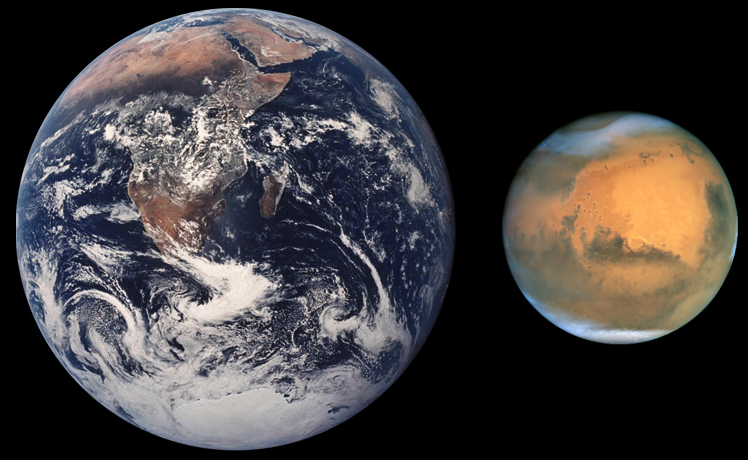
pogo wrote:Even without water Mars is closest to Earth, in many ways, not just distance-wise. It has similar gravity
Image

Mass: 0.107 Earths (nearer a tenth than a ninth).

Gravity: 0.376 g (a little over a third, but a lot less than half)

Mars is cold. Very cold. It would be like living in the Antarctic but needing oxygen shipped in bulk, and without any hope of going outside.
Venus is too inhospitable;
At the moment. We could perhaps change that, it wouldn't be easy, but if it was possible the benefits of having another available planet would be considerable. Plants would love the CO2, but would need water, a big comet might be enough.
Mercury is maybe cool enough at the poles but would be challenging (though you'd not lack for solar power). Everywhere else is much further away (Jupiter++) and/or s much smaller (Mars's moons, the asteroids).
Not even the moons of Jupiter or Saturn are big enough to have enough gravity to have an atmosphere.
A more plausible goal would be to visit the asteroids: further but without Mars's gravity well saving on the massive energy costs of landing and taking off. Not as sexy as Mars but probably more useful as anything we find there would be much easier to exploit. But even there much of the exploration can and should be done with probes first, ones as complex as the ones sent to Mars (again it would be cheaper as you don't need to land the thing).

Then establish a base there: something like the ISS except more self-sustaining so it can go longer without visits, and with enough power so it can drive itself between asteroids. Only then look at landing on Mars or further afield. By then we'll have sent many more probes and so know much more about the planet, such as where you can find water. We'll also have hopefully landed machines on other possible targets, such as Mercury, the moons of the outer planets, and know as much about them as we know about Mars today.
Earth's moon first, then some nearby asteroid I think, but that is right, low gravity makes landing and leaving again much easier. However, the first step is LEO.
"My way is the way of not fighting":- the book of Enter the Dragon.
User avatar
pogo
Sheepie Whore
Sheepie Whore
Posts: 14180
Joined: Tue Sep 10, 2002 8:28 pm 0
Yahoo Messenger: BrassSparrow
Location: County Durham

Re: stupid physics questions

Post by pogo »

None of these places have an atmosphere we can use, so wherever you go you'll live indoors, or go outside only in spacesuits. This works for you in one way though: a vacuum is an excellent insulator. So on Mars where its cold keeping warm would be relatively straightforward. In fact you'd probably have to take care not to get too warm: if you used the sun for warmth and light it would be like living in a greenhouse without anywhere for the heat to escape. On Mercury where it's hot as long as you keep out of the Sun, so live e.g. in the shade, the lack of atmosphere would similarly help insulate you.

Venus is another matter altogether. Not only is it much hotter but much denser, which would work the opposite way and cook anything down there very quickly. You'd need protecting against the pressure and heat, as well as maybe the chemical effects of the atmosphere. It would be difficult to move and see, more like working at the bottom of the ocean. Of course we're very familiar with doing that but on Earth with bulky equipment supported from a ship or platform.

Terraforming it so it's more like Earth would be impossible: the cost is quite inconceivable. Somehow you'd have to remove most of the atmosphere and it has many times as much of that as Earth. Think of all we're doing here, pumping CO2 into the atmosphere, as a side effect of almost all of our energy consumption (so we could not do more of it if we tried). CO2 in the air has risen by about 100 parts per million, so 0.01%. Now imagine removing (to where?) all the CO2 on Venus, about a million times as much as the CO2 here.

As for the Moon we've already been and brought back material. There's little I think of interest there: it's sterile, formed from the same material as Earth, and as a platform for e.g. further exploration or a source of materials is of little use because of the extra cost of launching from there.
User avatar
Darkflame
Sheepie Whore
Sheepie Whore
Posts: 18236
Joined: Mon Mar 31, 2003 11:06 am 0
Location: Not the UK

Re: stupid physics questions

Post by Darkflame »

On mars you'd live underground I think.

Also, pretty sure water has been confirmed to still exist on mars in ice form. Probably dirty of course.
Still, easier to melt and clean then it is to bring it with us.
So you'd probably want a base near enough to a polar region to pump that water to you.

I think you'd also try to genetically engineer some plants to live in the Martian soil, rather then relay totally on greenhouses.
User avatar
zip accident
Sheepie Whore
Sheepie Whore
Posts: 13928
Joined: Sun Feb 20, 2005 1:58 pm 0
Location: Bristol, UK

Re: stupid physics questions

Post by zip accident »

zip accident wrote:Mass: 0.107 Earths (nearer a tenth than a ninth).
Oops, nearer a ninth (which is 0.111 recurring).
Not even the moons of Jupiter or Saturn are big enough to have enough gravity to have an atmosphere.
Should be "a human breathable atmosphere".
pogo wrote:None of these places have an atmosphere we can use, so wherever you go you'll live indoors, or go outside only in spacesuits. This works for you in one way though: a vacuum is an excellent insulator. So on Mars where its cold keeping warm would be relatively straightforward. In fact you'd probably have to take care not to get too warm: if you used the sun for warmth and light it would be like living in a greenhouse without anywhere for the heat to escape. On Mercury where it's hot as long as you keep out of the Sun, so live e.g. in the shade, the lack of atmosphere would similarly help insulate you.
Mars has an atmosphere, it's not breathable but it's not a vacuum. There is a problem with Mars, it has enough gravity to make getting off again difficult, so it would be a one way trip. I wouldn't have a problem with it being a one way trip if living on Mars were going to be problem free, but it probably won't be, and there's no escape if/when something goes wrong. If we go to Mars as a one way trip I estimate the life expectancy of the explorers at one or two years, and that's not long enough.
Venus is another matter altogether. Not only is it much hotter but much denser, which would work the opposite way and cook anything down there very quickly. You'd need protecting against the pressure and heat, as well as maybe the chemical effects of the atmosphere. It would be difficult to move and see, more like working at the bottom of the ocean. Of course we're very familiar with doing that but on Earth with bulky equipment supported from a ship or platform.

Terraforming it so it's more like Earth would be impossible: the cost is quite inconceivable. Somehow you'd have to remove most of the atmosphere and it has many times as much of that as Earth. Think of all we're doing here, pumping CO2 into the atmosphere, as a side effect of almost all of our energy consumption (so we could not do more of it if we tried). CO2 in the air has risen by about 100 parts per million, so 0.01%. Now imagine removing (to where?) all the CO2 on Venus, about a million times as much as the CO2 here.
The main problem is the heat, a sun shade could fix that, there is a Lagrange point directly sunward of any planet so the shade could sit there, if it was of low mass, which we would want it to be for cost reasons it would have to be used as a sail to keep it there, but I believe that's possible. If the heat were fixed we could drop in water, plant seeds, and soil worms, then more complex organisms as time went on. Plants would love the CO2 as I've said before. Comets are mostly water I think, so a few of those might do it. We'd need to be sure there was no life there already of course, but if not then I can't see a problem with dropping comets on Venus.

Image

http://ga.water.usgs.gov/edu/earthhowmuch.html

We don't need all of the large sphere, that includes the oceans, we would only need the fresh water sphere, though the oceans would be nice if we could find that much.

There would be some water present in the clouds of H2SO4 I don't know what would happen to that when the temperature dropped, it might come down as acid rain, that would be difficult to deal with, but the dissociation of the CO2 into carbon and oxygen would mean that the H2SO4 would probably be reduced. All of that would need to happen before we sent people. It wouldn't be a quick process, but compared to making Mars comfortable, in a longer term view it's much more plausible.
As for the Moon we've already been and brought back material. There's little I think of interest there: it's sterile, formed from the same material as Earth, and as a platform for e.g. further exploration or a source of materials is of little use because of the extra cost of launching from there.
We know we can launch from the Moon, so it's not a one way trip even at this point in time. It's not for the benefits of going there itself (they might not be totally null) that we should go, but as a step on the way to going further, you have to learn to walk before you can run, and we can safely go to the Moon.
Darkflame wrote:On mars you'd live underground I think.
Anywhere other than a terraformed Venus, that's pretty much a given.
Also, pretty sure water has been confirmed to still exist on mars in ice form. Probably dirty of course.
Still, easier to melt and clean then it is to bring it with us.
So you'd probably want a base near enough to a polar region to pump that water to you.
Water is also allegedly present on the Moon.
I think you'd also try to genetically engineer some plants to live in the Martian soil, rather then relay totally on greenhouses.
There's no liquid water. It's too cold. Any oxygen they produce in the martian atmosphere will be lost to space due to the low gravity.
"My way is the way of not fighting":- the book of Enter the Dragon.
User avatar
Darkflame
Sheepie Whore
Sheepie Whore
Posts: 18236
Joined: Mon Mar 31, 2003 11:06 am 0
Location: Not the UK

Re: stupid physics questions

Post by Darkflame »

I was thinking for simply for food - not teraforming a atmosphere.

Theres life that exists in all extremes on earth, so I think theres good evidence life would be possible temperature wise. Theres at least natural bacterias that can survive surface Martian lows, so deliberately engineered organisms to do so should be possible.

You'd need irrigation, of course. Thats relatively easy though.
User avatar
zip accident
Sheepie Whore
Sheepie Whore
Posts: 13928
Joined: Sun Feb 20, 2005 1:58 pm 0
Location: Bristol, UK

Re: stupid physics questions

Post by zip accident »

Darkflame wrote:You'd need irrigation, of course. Thats relatively easy though.
Not below the freezing temperature of water it isn't.
"My way is the way of not fighting":- the book of Enter the Dragon.
User avatar
pogo
Sheepie Whore
Sheepie Whore
Posts: 14180
Joined: Tue Sep 10, 2002 8:28 pm 0
Yahoo Messenger: BrassSparrow
Location: County Durham

Re: stupid physics questions

Post by pogo »

zip accident wrote:The main problem is the heat, a sun shade could fix that, there is a Lagrange point directly sunward of any planet so the shade could sit there, if it was of low mass, which we would want it to be for cost reasons it would have to be used as a sail to keep it there, but I believe that's possible. If the heat were fixed we could drop in water, plant seeds, and soil worms, then more complex organisms as time went on. Plants would love the CO2 as I've said before. Comets are mostly water I think, so a few of those might do it. We'd need to be sure there was no life there already of course, but if not then I can't see a problem with dropping comets on Venus.
Really I don't think you grasp what would be needed. Venus's main problem is it has an excess of atmosphere

http://en.wikipedia.org/wiki/Venus#Atmo ... nd_climate

93 times that of Earth. That extra mass means a much higher pressure which you need protecting from. This is not only more expensive than dealing with a vacuum but you also need to add in insulation, as the vacuum doesn't insulate you, and protection against chemical and electrical effects of it (storms with acid rain - the clouds are sulphuric acid). Plus you'd be unable to move.

We can't live in that, nor can our animals or plants. Basically you'd need to remove almost all of that atmosphere and transform what's left: get rid of it all and replace it with the Nitrogen-Oxygen mix we breathe. How? Where would you put it? Remember all the burning and combustion we've been doing on Earth has increased CO2 by a hundredth of a percent. That's 1/10,000 of our atmosphere, or about 1/1,000,000 that of Venus.

Venus has another problem: it's the only planet except the gas giants that would be much harder to get off than Earth. While it's at least conceivable you could land people on Mars and get them off it would be impossible on Venus, or at least require energy an order of magnitude greater than getting people off Earth, while it has such a thick atmosphere. Even once terraformed it would be as difficult as leaving Earth. For a very long time it would be a one way trip.
User avatar
Darkflame
Sheepie Whore
Sheepie Whore
Posts: 18236
Joined: Mon Mar 31, 2003 11:06 am 0
Location: Not the UK

Re: stupid physics questions

Post by Darkflame »

zip accident wrote:
Darkflame wrote:You'd need irrigation, of course. Thats relatively easy though.
Not below the freezing temperature of water it isn't.
Heat it?
Venus has another problem: it's the only planet except the gas giants that would be much harder to get off than Earth. While it's at least conceivable you could land people on Mars and get them off it would be impossible on Venus, or at least require energy an order of magnitude greater than getting people off Earth, while it has such a thick atmosphere.
What about using the atmospheric thickness as an advantage, and using balloons?
Post Reply