Politics Thread!

Inane baanter or words of wisdom - you decide...
Post Reply
User avatar
(o)(o)
Baaaaaaa!
Baaaaaaa!
Posts: 6885
Joined: Tue Jan 19, 2010 2:21 am 0

Re: Politics Thread!

Post by (o)(o) »

People do travel by rail as a leisure activity. The privatisation of the rail networks has done a lot more socially for this country than anything Labour ever did. You get to relax, and meet new people.

The problem with mass transportation by rail is that it's relies on a limited number of fixed routes and destinations so it's not very flexible, and it causes people to congregate in one place causing overcrowding. This is especially so since the privatisation of rail has attracted so many more people to travel on it. The solution to this is to increase ticket prices to deter abuse of the networks.

That would also have clear benefits for, as you can see from this graph :

Image
User avatar
pogo
Sheepie Whore
Sheepie Whore
Posts: 14180
Joined: Tue Sep 10, 2002 8:28 pm 0
Yahoo Messenger: BrassSparrow
Location: County Durham

Re: Politics Thread!

Post by pogo »

gravy wrote:
Driving is just fucking horrible compared to twenty years ago. Even though there's not been a horrendous increase in population it only takes breaching a tipping point to overload road infrastructure and for driving to suck balls.

On top of that it's got a lot more expensive too. It's an increasingly unpleasant option.
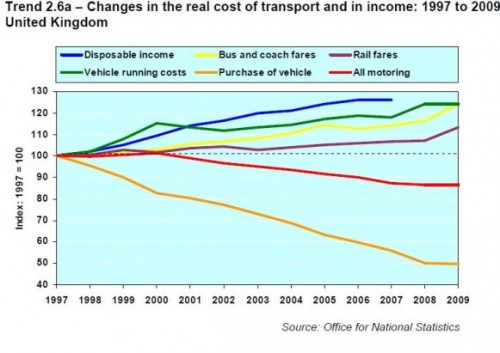
Nonsense. One thing I'm sure of is car driving has gotten a lot cheaper. While bus and rail costs have risen faster than inflation motoring's gone down:
Image
Image
Cars have gotten much more efficient, reliable (so they last longer and cost less to maintain), safer (reducing insurance costs), and more secure (reducing theft/damage costs).

For a short while the fuel price escalator counteracted this but that was abandoned long ago. The trend in costs has been inexorably downwards. Which has led to more and more cars on the road and so congestion, so from that point of view it's gotten worse, but not enough to put off most drivers.
User avatar
gravy
Sheepie Whore
Sheepie Whore
Posts: 19572
Joined: Wed May 01, 2002 1:28 pm 0
Location: The Other Place

Re: Politics Thread!

Post by gravy »

Those figures are nonsense if you're trying to draw any conclusions about the motivations for people travel choices.

Fuel costs are a massive factor for anyone doing a length commute, the kind where you'd be more likely to making a choice between driving or using the train. You've posted a graph that allocates an average mileage / fuel cost per household.

Which is an obvious load of shit.

Measured against the RPI petrol prices have doubled in the last twenty years.

You're exactly right that there's been a big increase in car reliability but for a while it's been incremental claims, the big step change in car quality had already happened in 93.
User avatar
pogo
Sheepie Whore
Sheepie Whore
Posts: 14180
Joined: Tue Sep 10, 2002 8:28 pm 0
Yahoo Messenger: BrassSparrow
Location: County Durham

Re: Politics Thread!

Post by pogo »

That graph starts from 1997 but shows the contribution from purchasing a vehicle almost halving over the period, a combination of cheaper vehicles and much greater reliability; improvements didn't stop in 1993.

As for petrol it's gotten more expensive with the oil price, petrol prices have risen much less proportionally than oil because such a large part of the price is tax which has been falling as a % of petrol costs since the fuel price escalator ended. And with incomes rising and cars getting more efficient it's gotten more affordable.

One indication: 14 years ago people were on the streets, blockading oil refineries, as petrol reached stratospheric levels of 80p a litre ! Petrol now costs £1.30 or more, more than 50% more, but people aren't protesting; inflation and incomes have risen more.
User avatar
tufty
Sheepie Whore
Sheepie Whore
Posts: 12523
Joined: Fri Jan 07, 2005 4:52 pm 0
Location: French Alps

Re: Politics Thread!

Post by tufty »

OK, I'm back.

Now then, pogo's argument is, as usual, based on interpreting (or, if you prefer, misinterpreting) a single data point as being in favour of his viewpoint, ignoring al other data points.

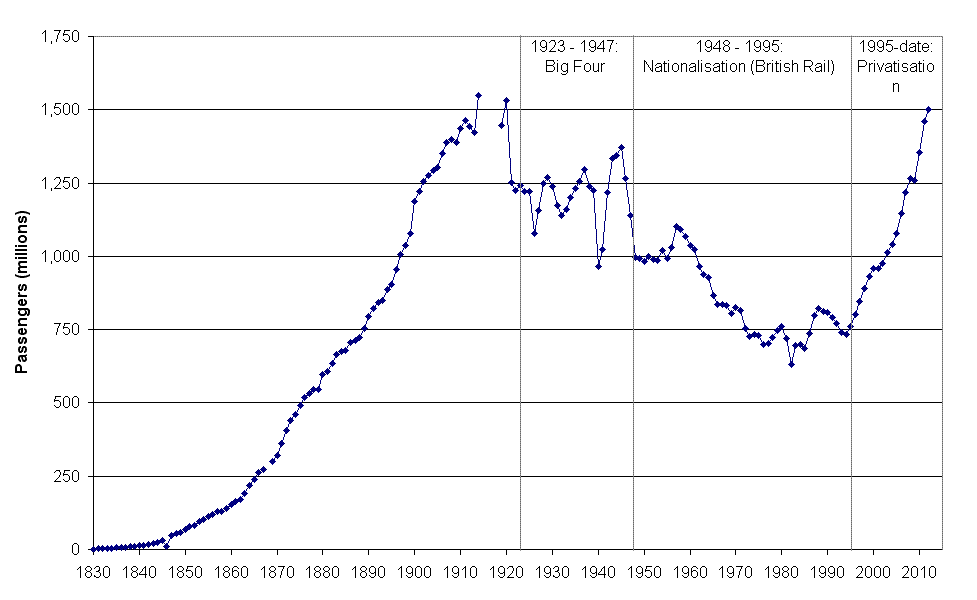
In this case, he's talking about passenger numbers on the trains, which have indeed doubled since privatisation. Viewed in isolation, ignoring all other factors which might cause rail travel to increase, that's a pretty good argument. Not viewed in isolation, it makes pogo look like a credulous cockend.

For starters, rail travel numbers had been "on the up" since 1982, which, perhaps coincidentally, coincides with Thatcher's government changing the way British Rail were run. I'll come back to that later. So, unless privatisation is somehow magically retroactive, it can't be the only thing causing passenger numbers to rise.

A more convincing argument is given on page 116 of the report I linked earlier, which shows a correlation between ΔGDP and ΔPassengers - in short, when GDP goes up, passenger numbers go up, and vice versa. We're talking to pogo here, so here's a graph:

Image

Rail journeys as a percentage of total journeys has, of course, continually reduced.

In short, crowing "passenger numbers have doubled" without considering anything else is, at best, meaningless in terms of determining how successful privatisation has been.

So, how would we measure the success of rail privatisation (from the point of view of the passenger and / or taxpayer)? A few that spring to mind are :

- Rail system still exists
- Rail system provides required service
- Rail system and is affordable for passengers
- Rail system is independent of government subsidy (or, at least, costs less than the publically-owned system)

The first two are fine, the third is questionable, and the third is where it all goes pear-shaped.

Now, Thatcher's government, in 1982, introduced new management practices to British Rail and restructured it. Part of that reform was an ongoing, year-on-year, mandated reduction in rail subsidy. British Rail in 1982 was costing the country 1.3 billion to run, after all. Until 1989, rail subsidy reduced on a straight line graph.

Following Thatcher's exit in 1990, rail subsidy increased, in 1992 it was up to double the level it was in 1982. British Rail was being "fattened up" for privatisation. Post privatisation, subsidy dipped to a new low in 1996, but otherwise has never been below 1982 levels, let alone 1989. Graph time:

Image

So, far from selling off a "lame duck", we've handed off management of that lame duck to uncontrollable third parties, and handed over more and more money to them to keep them running it. The private rail system is costing the taxpayer a fortune.

What's even more ironic is that, as certain of the TOCs are subsidiaries of other countries' rail systems (notably Deutsche Bahn and the SNCF), we're handing over UK taxpayers' money to run other countries' publically owned rail systems.

It's a success!

Also, (o)(o), +eleventy-one internet points for you.
"massive retard™", "full of shit™", "tiny bitch™", "retarted™", "a bit of a one trick pony™", "petty™", "simple minded idealistic twat™", "miserable humourless fucker™"
adam
Baaaaaa!
Baaaaaa!
Posts: 4418
Joined: Sat Jun 24, 2006 9:15 pm 0

Re: Politics Thread!

Post by adam »

Darkflame wrote: Now I havnt used the ferry in awhile now because of this stupidity (despite liking the ferry service itself).
they're doing 45 euro singles from any dutch station to london now (or any station in essex)
User avatar
pogo
Sheepie Whore
Sheepie Whore
Posts: 14180
Joined: Tue Sep 10, 2002 8:28 pm 0
Yahoo Messenger: BrassSparrow
Location: County Durham

Re: Politics Thread!

Post by pogo »

tufty wrote:For starters, rail travel numbers had been "on the up" since 1982, which, perhaps coincidentally, coincides with Thatcher's government changing the way British Rail were run. I'll come back to that later. So, unless privatisation is somehow magically retroactive, it can't be the only thing causing passenger numbers to rise.

A more convincing argument is given on page 116 of the report I linked earlier, which shows a correlation between ΔGDP and ΔPassengers - in short, when GDP goes up, passenger numbers go up, and vice versa.
I don't accept this, as it breaks down in a number of ways. First, not cherry picking e.g. 1982 which was the lowest point in 100+ years and of course the middle of a recession you can see two trends. An uneven but long term decline in numbers up to the 1990s before rapidly rising from the mid 1990s onwards:

https://upload.wikimedia.org/wikipedia/ ... y_year.gif

There's not a clear, simple, relationship between ΔGDP and ΔPassengers. Or at least if there was one over most of the 20th century it was negative; as GDP improved people used trains less, this trend reversing in the 1990s; it can't be just because of GDP.

For one the main reason we do things more as GDP improves is they get more affordable; we buy more cars, or more phones, or foreign holidays, as they're cheaper relative to our incomes. But rail travel has gotten more expensive, not just in real terms but ahead of rises in income so less affordable. And even if there were some relationship GDP's not doubled. Passenger numbers have increased far ahead of any rise in GDP.

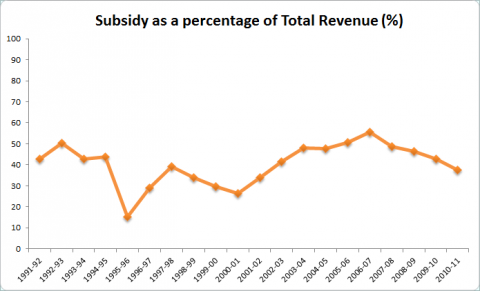
As for the subsidy it looks impressive until you compare it to revenue. Here's a graph that does just that

Image

Passenger numbers have doubled, and fares have increased ahead of inflation, so revenues have more than doubled. The subsidy's not risen that much as a percentage, and is less than its peak in 1992/93. And again there's no obvious transmission mechanism: if the increased subsidy had made fares cheaper then it might account for the growth in numbers but fares are more expensive, not cheaper.
User avatar
gravy
Sheepie Whore
Sheepie Whore
Posts: 19572
Joined: Wed May 01, 2002 1:28 pm 0
Location: The Other Place

Re: Politics Thread!

Post by gravy »

User avatar
pogo
Sheepie Whore
Sheepie Whore
Posts: 14180
Joined: Tue Sep 10, 2002 8:28 pm 0
Yahoo Messenger: BrassSparrow
Location: County Durham

Re: Politics Thread!

Post by pogo »

Yes, the reason why we're discussing railways. My entire complaint can be summarised from the first paragraphs.
Labour delegates hailed a new deal on rail policy as the "beginning of the end of Tory privatisation" as the party agreed to review the entire "failed" franchising system and to allow let public sector operators to compete to run services.
...
Under the agreement, Labour will conduct a review into a franchising system which it says has let down passengers with poor value for money and some of Europe's highest fares.
"failed" how? Let down how? You can argue about how some of the privatisations were done but rail has been stunningly successful since privatisation. People are voting with their feet and taking the train in numbers not seen for 100 years.

There are many dangers with part renationalisation. If govt. not-for profit firms can compete for franchises it will drive away private firms, pricing in profit, their cost of raising capital and risk. It will quickly become entirely state-owned which is probably the intention of some. The access agreements negotiated between train operators and National Rail. How will the government negotiate with itself? The danger is these negotiations will become meaningless: central govt will just treat the bits of the railway system as one, for the purpose of e.g. subsidy. Again private firms will be disadvantaged unable to benefit from this cosy relationship.

If they want lower fares then change the way fare increases are calculated, then be prepared to pay a larger subsidy. Government shouldn't be running trains, no more than they should be making cars or running airlines.
User avatar
gravy
Sheepie Whore
Sheepie Whore
Posts: 19572
Joined: Wed May 01, 2002 1:28 pm 0
Location: The Other Place

Re: Politics Thread!

Post by gravy »

pogo wrote:"failed" how? Let down how? You can argue about how some of the privatisations were done but rail has been stunningly successful since privatisation.
I guess it's for the many reasons outlined above; the rail system costs the tax payer more than it did when it was privatised.

That doesn't even factor in the cost of the collapse of Railtrack which is ultimately being reprivatised now it has £140bn debt.

That's a failure isn't it?

EDIT!

Oops, overegged the debt. It's 'only' £30bn that's going to be added to the national debt. So yeah, sorry pogo, "stunningly successful" it is :D
User avatar
VNVObit
Baaaaaa!
Baaaaaa!
Posts: 4072
Joined: Sun Jan 01, 2006 10:03 pm 0
XBL Gamertag: vnvobit
PSN: VNV_Obit
Location: London

Re: Politics Thread!

Post by VNVObit »

pogo wrote:
tufty wrote:For starters, rail travel numbers had been "on the up" since 1982, which, perhaps coincidentally, coincides with Thatcher's government changing the way British Rail were run. I'll come back to that later. So, unless privatisation is somehow magically retroactive, it can't be the only thing causing passenger numbers to rise.

A more convincing argument is given on page 116 of the report I linked earlier, which shows a correlation between ΔGDP and ΔPassengers - in short, when GDP goes up, passenger numbers go up, and vice versa.
I don't accept this, as it breaks down in a number of ways. First, not cherry picking e.g. 1982 which was the lowest point in 100+ years and of course the middle of a recession you can see two trends. An uneven but long term decline in numbers up to the 1990s before rapidly rising from the mid 1990s onwards:

https://upload.wikimedia.org/wikipedia/ ... y_year.gif

There's not a clear, simple, relationship between ΔGDP and ΔPassengers. Or at least if there was one over most of the 20th century it was negative; as GDP improved people used trains less, this trend reversing in the 1990s; it can't be just because of GDP.

For one the main reason we do things more as GDP improves is they get more affordable; we buy more cars, or more phones, or foreign holidays, as they're cheaper relative to our incomes. But rail travel has gotten more expensive, not just in real terms but ahead of rises in income so less affordable. And even if there were some relationship GDP's not doubled. Passenger numbers have increased far ahead of any rise in GDP.

As for the subsidy it looks impressive until you compare it to revenue. Here's a graph that does just that

Image

Passenger numbers have doubled, and fares have increased ahead of inflation, so revenues have more than doubled. The subsidy's not risen that much as a percentage, and is less than its peak in 1992/93. And again there's no obvious transmission mechanism: if the increased subsidy had made fares cheaper then it might account for the growth in numbers but fares are more expensive, not cheaper.
The last paragraph undermines your statement. Looking at a double in passengers and say 2.5% average price increase over a 10 year period would reduce the subsidy to 25% (graph is north of that) assuming subsidy kept in line with inflation (for maths go here

If it were kept at original levels it'd be more like 1% and your graph shows no such decline over the period. Success for the taxpayer would be somewhere south of 25% at the end of 10 years and the closer to 1% the more like a true success.

All the graph suggests is that the government would have been better off doing a single capital payment in full and final settlement and then see how the TOCs faired
"England is funny, but sometimes she scares me"
Tony Wakeford

My avatar is the cover of Tower of Babel's first single

"Sky is not roof, Earth is not bottom, the world is not yours, you are the world's" from Brown by Grotus
User avatar
pogo
Sheepie Whore
Sheepie Whore
Posts: 14180
Joined: Tue Sep 10, 2002 8:28 pm 0
Yahoo Messenger: BrassSparrow
Location: County Durham

Re: Politics Thread!

Post by pogo »

VNVObit wrote:If it were kept at original levels it'd be more like 1% and your graph shows no such decline over the period. Success for the taxpayer would be somewhere south of 25% at the end of 10 years and the closer to 1% the more like a true success.
If by success you mean paying as little as possible. But cutting so much of the subsidy would also mean a much smaller rail service. I suspect little of it would be viable, maybe just the commuter belt around London. And even that would probably be closed down and sold off if run like a private company: the land the railways run on, the stations and tracks, is far more valuable today than when the railways were founded and stations were sited on cheap land away from the city centre.

I think we need railways. They have at least big benefits, providing mid to long distance journeys to people without cars (and quite a few with), reducing congestion, reducing carbon emissions. I.e. there are social, economic and green benefits. It would be a mistake to cut the subsidy so much that this ended.
User avatar
gravy
Sheepie Whore
Sheepie Whore
Posts: 19572
Joined: Wed May 01, 2002 1:28 pm 0
Location: The Other Place

Re: Politics Thread!

Post by gravy »

Well we agree on that.

But that's not privatisation.

Or at the very least a really woefully unsuccessful one.
User avatar
(o)(o)
Baaaaaaa!
Baaaaaaa!
Posts: 6885
Joined: Tue Jan 19, 2010 2:21 am 0

Re: Politics Thread!

Post by (o)(o) »

If it is a successful privatisation, shouldn't the same model be followed for buses?

You can make similar arguments for the "social, economic and green benefits"

Many of us rural folk no longer have bus routes that can get us to a train - there wasn't enough profit in it so those routes were cancelled - so pretty much everyone in rural areas has to own a car.
User avatar
(o)(o)
Baaaaaaa!
Baaaaaaa!
Posts: 6885
Joined: Tue Jan 19, 2010 2:21 am 0

Re: Politics Thread!

Post by (o)(o) »

Oh hang on - funding is being cut. :?

Image
Post Reply