OK, I'm back.
Now then, pogo's argument is, as usual, based on interpreting (or, if you prefer, misinterpreting) a single data point as being in favour of his viewpoint, ignoring al other data points.
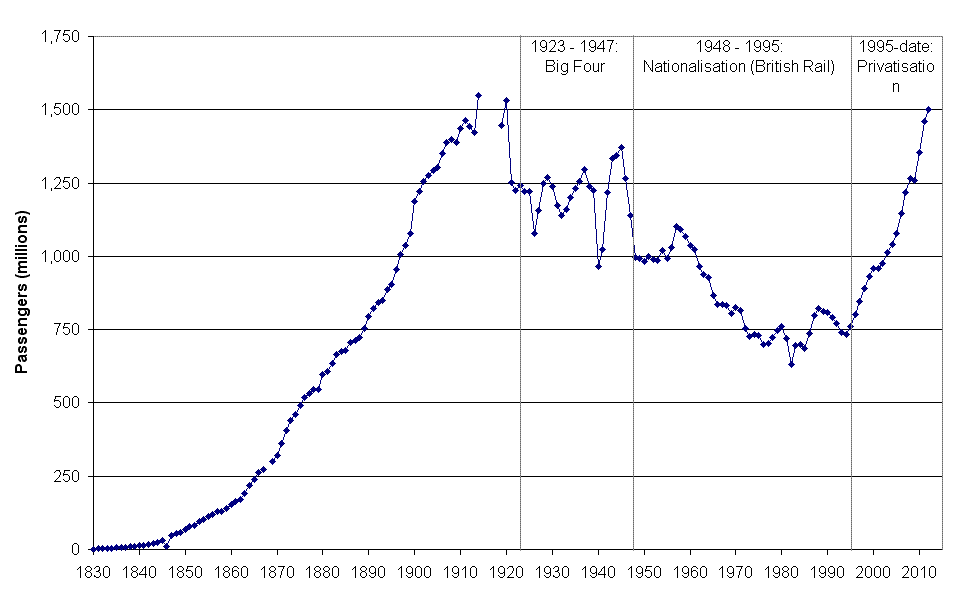
In this case, he's talking about passenger numbers on the trains, which have indeed doubled since privatisation. Viewed in isolation, ignoring all other factors which might cause rail travel to increase, that's a pretty good argument. Not viewed in isolation, it makes pogo look like a credulous cockend.
For starters, rail travel numbers had been "on the up" since 1982, which, perhaps coincidentally, coincides with Thatcher's government changing the way British Rail were run. I'll come back to that later. So, unless privatisation is somehow magically retroactive, it can't be the only thing causing passenger numbers to rise.
A more convincing argument is given on page 116 of the report I linked earlier, which shows a correlation between ΔGDP and ΔPassengers - in short, when GDP goes up, passenger numbers go up, and vice versa. We're talking to pogo here, so here's a graph:

Rail journeys as a percentage of total journeys has, of course, continually reduced.
In short, crowing "passenger numbers have doubled" without considering anything else is, at best, meaningless in terms of determining how successful privatisation has been.
So, how would we measure the success of rail privatisation (from the point of view of the passenger and / or taxpayer)? A few that spring to mind are :
- Rail system still exists
- Rail system provides required service
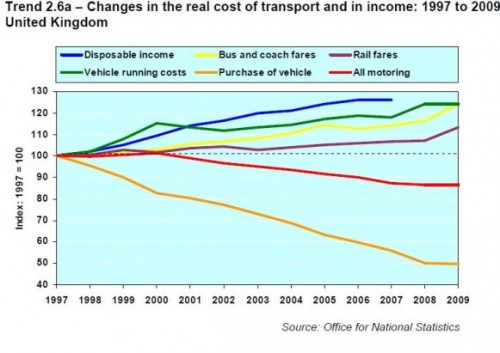
- Rail system and is affordable for passengers
- Rail system is independent of government subsidy (or, at least, costs less than the publically-owned system)
The first two are fine, the third is questionable, and the third is where it all goes pear-shaped.
Now, Thatcher's government, in 1982, introduced new management practices to British Rail and restructured it. Part of that reform was an ongoing, year-on-year, mandated reduction in rail subsidy. British Rail in 1982 was costing the country 1.3 billion to run, after all. Until 1989, rail subsidy reduced on a straight line graph.
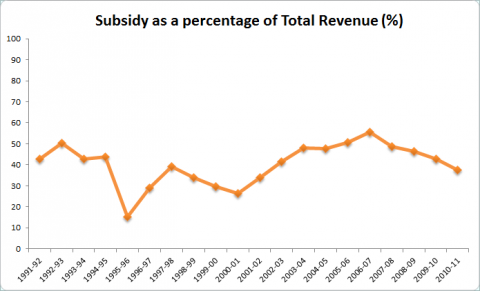
Following Thatcher's exit in 1990, rail subsidy increased, in 1992 it was up to double the level it was in 1982. British Rail was being "fattened up" for privatisation. Post privatisation, subsidy dipped to a new low in 1996, but otherwise has never been below 1982 levels, let alone 1989. Graph time:

So, far from selling off a "lame duck", we've handed off management of that lame duck to uncontrollable third parties, and handed over more and more money to them to keep them running it. The private rail system is costing the taxpayer a fortune.
What's even more ironic is that, as certain of the TOCs are subsidiaries of other countries' rail systems (notably Deutsche Bahn and the SNCF), we're
handing over UK taxpayers' money to run other countries' publically owned rail systems.
It's a success!
Also, (o)(o), +eleventy-one internet points for you.