Dio wrote:I'm certain that personally my mental and physical faculties are fine.
I actually caught it from natural infection - and suffered Long Covid - and I can tell you that I'm not at all certain that my mental faculties are entirely fine.
I mean, generally, they are.
But I have had moments of feeling a lack of "presence" (I mean that in the VR sense - like I don't quite feel like I'm there, slightly disconnected and "a step back" from reality). I also realise that this could be a description of anxiety / depression symptoms (though depression is commonly seen as "being sad", it's actually better described as a disconnection - not being able to connect or give a shit about things).
But this tallies with the study that had it that those who suffered from Covid (from natural infection) had a significantly higher chance of suffering from anxiety / depression afterwards.
In a sense, what you're saying is that the vaccines work. And they do.
But this speaks nothing of those who're unvaccinated. Or those who've been vaccinated but it didn't work - in the sense that, even with the third booster jab, it's still only estimated to be 70% effective against Omicron. And, in that number, we have to also include those who can't be reliably vaccinated (immuno-compromised).
And we have to see just how much Omicron has "gone boom" (these are world figures):
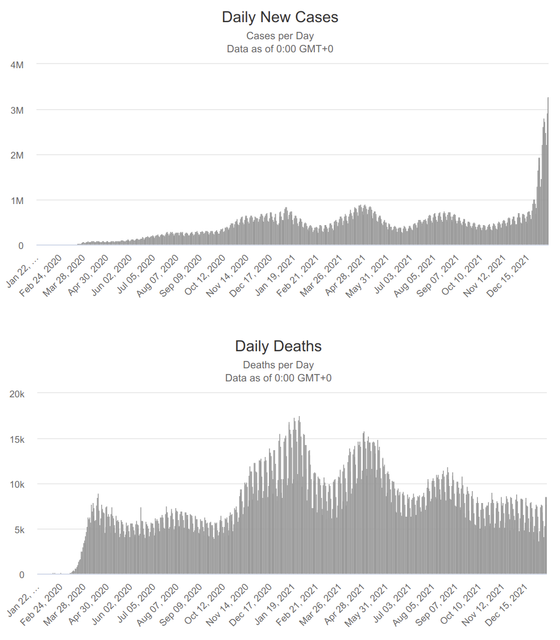
Like, look at this surge at the end. It's dwarfing everything we've ever previously seen in the last two years.
The good news is that the deaths graph - which is the same scale on the x axis, for comparison - hasn't seemingly budged, despite the explosion in cases. Indeed, it's kind of unaffected and continuing its steady slow decline.
And, yes, that's good news.
But, equally, the bad news is that the more cases there are, the more chance there is of brewing up yet more variants. In which case, that Omicron "spike" there is a very big problem.
And variants remain a problem. They really do.
Omicron itself proves that point. After all, we were all double jabbed and we were being promised a normal Christmas. We were on the way out. Then - bang! - Omicron strikes.
And then we need a third "booster" jab for the whole adult population (the boosters initially were only going to be for the most vulnerable) in a rush, because being double jabbed was suddenly not good enough. Indeed, when you get your third jab, you're "boosted" up to 70% protection.
And, like, 70% protection is not exactly amazing. That's 30% not-protection, which is almost a third. I mean, without the third jab, protection is much lower again - so that's why we all needed the third jab and you should get your booster jab. But, again, you're boosted up to 70%. While the vaccines were initially 90+% protection for the original strain.
That's quite a decline. Every new variant, though, will tend to do this. Slowly chip away at the vaccine efficacy. It's working its way, bit by bit, towards "vaccine escape".
So the vaccines work. But they increasingly work less well as the variants keep coming.
And with cases through the roof with Omicron, the virus is now getting to roll those "mutation dice" three times more often than it ever has.
Omicron itself shows us the problem. We had everyone double-jabbed - with quite a lot of natural infection too for natural immunity - and had built up quite the "immunity wall"... against the original strain, Alpha and (somewhat) Delta.
But Omicron could happily smash through that "immunity wall" without much problem, so - shit! - we need to get everyone in the world jabbed up a third time (and, even then, only to ~70% protection levels, which isn't amazing).
I mean, that's the thing. We're boosting up to 70%. So we were clearly significantly lower than 70% on just double jabs. You can see exactly why we definitely needed boosters. Because, yeah, if the "immunity wall" was only, say, 40% / 50% protective than that's shit and nowhere near good enough to keep Omicron in check at all.
The point is that this is a double-edged sword. There are aspects of Omicron that, undoubtedly, are good news. The biggest of which is that, despite that almighty massive spike in cases, it really hasn't touched the deaths graph.
And you can dig down to individual countries to see that's generally the pattern everywhere - except that it's not so much true in the countries with much lower vaccination rates, which suggests that, yes, it's the vaccines that are doing this. In the world graph and the UK graph (and much of the European graphs I've checked), then the "spikes" aren't really touching the deaths graph at all. There's, like, no reaction in the death graph to the existence of Omicron. That's massively good news (I was basically the first person on this thread to issue that potential good news with Omicron). But if you look at South Africa and other not-so-well-vaccinated countries, then there is a spike in deaths corresponding to Omicron - far, far less than any previous wave, thankfully, but it is there.
Basically, yes, the vaccines work. For the vaccinated, Omicron really has broken the link to hospitalisations and deaths.
BUT that doesn't hold for the unvaccinated. It might not hold so well for those who are vaccinated, but fall the wrong side of that "70% protected". And then there are those who cannot be vaccinated (immuno-compromised).
And if all these cases brew up a new variant, then the effectiveness of our current "immunity wall" could simply be by-passed and smashed down. As Omicron actually did - necessitating a new wave of jabs - but, thankfully, this variant hasn't been going after deaths.
I'm not here to either be "the prophet of doom" nor to "do a Boris" and be so enthusiastically optimistic about it all, as to be inevitably wrong.
We have to look at the good news and the bad news. Omicron has brought much good news. But also some bad.
Because - sorry to be the broken record - but cases DO matter. And, boy, has Omicron brought us an explosion of cases.
Mutation is random. So we could get lucky that, even with such a massive spike, we don't get any new "variant of concern". That could totally happen.
But it's a dice roll. A dice roll whether a new "variant of concern" will brew up (in a sense, with numbers like this, variants will definitely happen - as they always do - but it's, of course, the significantly different variants - Delta, Omicron - that change the nature of the game that we focus on). And a dice roll as to the characteristics that any new variant rolls up.
There is the thing that, generally, viruses will tend towards more transmission and less lethality - because a virus is trying to thrive, and is not actually trying to kill us and it's actually bad for the virus if it's killing too many of us too quickly, as it'll run out of hosts to infect - but it's not guaranteed that the next "variant of concern" necessarily immediately conforms to that.
Basically, there are two "forces" going on. Mutation is random. Natural selection is non-random. Mutation is flying off in random directions, then natural selection tidies up after it - narrows it down, cleans up the failures, "rewards" what works and "punishes" what doesn't. Evolution is kind of a tug-of-war between those two things.
Natural selection says that going towards "more transmission, less lethality" is a good thing. But mutation is just completely random. It's not listening to anyone. it could go in any random direction whatsoever - mutation is a "copying mistake", essentially, so it's governed by nothing but pure blind random chance. Then natural selection works on that and "tidies it up" afterwards.
Variants will, inevitably, tend towards that "more transmission, less lethality" because natural selection will select for that. But the variant-to-variant mutation? Completely a dice roll.
So, yes, many variants later, we'll have the "mild" endemic virus that Omicron has began to promise. But there's no guarantees that the next one after Omicron necessarily follows Omicron's pattern. Natural selection wants to take this down this path, but each individual variant itself might not comply (but, eventually, natural selection will win the battle over time, hence saying that it will eventually inevitably get there - but it could be a drunken wandering path, with dead-ends and doubling-back, to get there).
Is it good or is it bad?
Well, yes, it is. Neither pessimism nor optimism are automatically correct. There is good news and bad news here. Hopefully, though, the good news wins out - and it very well could actually do so, if things trot along as we see things now.
So, yes, we see the green shoots of recovery. And, barring alarms and surprises (e.g. a new "variant of concern" that decides to - again, like Omicron did - change all the rules), this goes down the optimistic path. But it might not.
And that's not "the prophet of doom" - as I'm mostly optimistic, like Dio - but just, you know, correctly caveating it all with the "...and this is how it could go wrong from here" conditionals that it needs to have.
Once more for the road: Cases DO matter.
"Words ought to be a little wild - for they are assaults of thought on the unthinking."
- John Maynard Keynes


