Yeah, this is an old idea, from the good Reverend Thomas Malthus:
https://en.wikipedia.org/wiki/Malthusianism
The gist of it is that Malthus noted that population growth is potentially exponential, while the growth of the food supply and other resources are linear.
And, therefore, logically, population growth could potentially outpace resource growth, meaning that there would be shortages, famines, wars over resources, etc. causing what's known as a "Malthusian collapse".
But it's also worth noting that Malthus was writing this in 1798, and writing it
before Darwin.
Thus, there is no sense within it that, like, perhaps evolution has already thought about this. That, over some 3.5 billion years, humans are hardly the first organism to which this might apply.
There's two maps that you need to see. The first is a mapping of the "human development index", which is a measure of one's quality of life / standard of living:
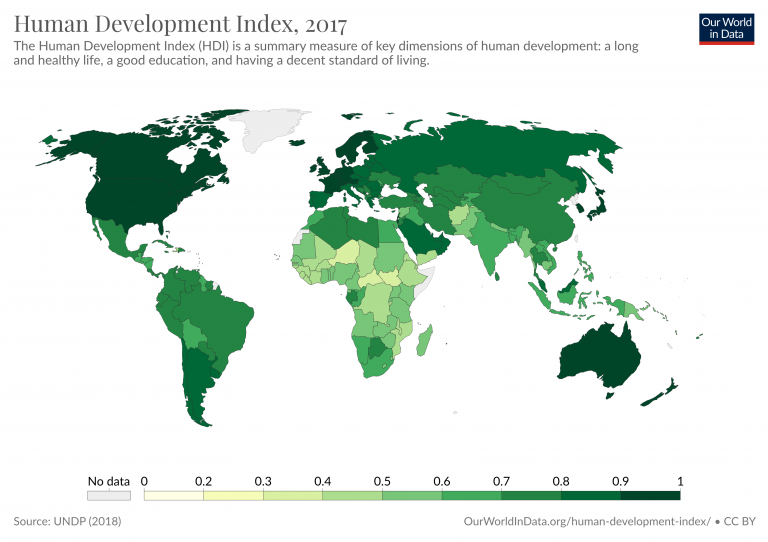
And then the world map of "children born per woman" - the fertility rate - to compare it against:

Do the "compare and contrast". Mentally overlay one on the other.
Then, in that second map, note that all that pale yellow represents < 2 children per woman (and as it takes a man and a woman to make a baby that's 2 people creating less than 2 people to eventually replace them).
The "replacement value" is around 2.2 children per couple. Yeah, it's a little above two, as one has to take into account infant mortality - some children born never reach the age to have children of their own, so the "replacement value" is a little higher than "two kids to replace mum and dad".
So, basically, look how much of the planet is below 2 - which means the native population is shrinking. And quite a lot of it is 2 - 2.5 as well, which is kind of sitting around "replacement value", the point of replacement, where it ain't growing nor shrinking, but staying the same.
And the thing to note is that - excluding China, which actively had a "One Child" policy for a while to implement population control (which explains why its fertility rate is a bit lower than what you'd expect for its HDI ranking) - this all happened naturally.
Every modern industrialised nation is below replacement value. As the whole world's standard of living rises, so that fertility rate drops.
And where it remains high? The poor and war-torn nation of Afghanistan. The poor and war-torn nations of Central Africa - loosely where the Congolese War happened.
And this trend holds historically too. We've all heard about "2.4 children" - but that statistic comes from the post-war "baby boom". The last time we breached "replacement value" - and rose above that 2.2 to actually increase our population - was in the aftermath of two World Wars and the pandemic in-between.
(In a sense, the clue is in the question: the
post-war baby boom. Making up the difference after two wars and a pandemic decimated our numbers. And, by the way, "2.4 children" is only just above replacement value. It's only just a population increase.)
I know. These numbers play a little havoc with our notions of "freewill", as we like to think we choose to have children or not. But the correlation is solid and also holds historically.
If you want to increase the population, then plunge everyone into poverty and start a brutal war (and a global plague also doesn't help). If you want to decrease the population, then raise the standard of living and live in peace and prosperity.
If Malthus had known of Darwinism and had access to this data, he might have realised: Evolution has already thought of it. Our collective inclination to have more children is in response to negative pressure against our current population. When wars and famine attack our numbers, the evolutionary response is to have more babies to make up that difference. But when all is good - without any prompting nor cajoling - our collective inclination drops to below "replacement value", so the population drops, as then the biggest threat to us is, in fact, Malthus's observation that, with vastly too many of us, we threaten the available resources to sustain us.
Makes perfect evolutionary sense. Over-population does threaten resources. So - in some shared common ancestor, over our 3.5 billion year journey to humanity - this basic instinct to keep the numbers steady (and actually bob up and down around replacement value) was forged and we inherited it.
A basic instinct to (crudely) match the available resources. Makes evolutionary sense, right? That natural selection would have hit upon an answer to this, in the 3.5 billion years it's been in operation. To provide a built-in "over-population avoidance" mechanism within life itself. It's already there - nature already thought of this long, long before we ever did.
Unfortunately, an additional problem with humanity is that we do silly things like declare war on each other, or the rich hold the poor in poverty to exploit them, or behave irrationally in the face of a pandemic, triggering this instinct to up the population, when we really, really, really don't need that right now.
The solution is already there. And the Beatles were right, it's actually "peace and love". Brotherly love, to raise our collective standard of living. To give a shit about the poor, and raise them up to not feel that their survival is threatened. To live in peace and settle our disputes by trade and the law courts.
If we can keep that up - for everyone - then the whole world map above will become that pale yellow, representing less than "replacement value", and the population will stabilise on its own. Granted, there is, unfortunately, a time lag on this - the "boomers" will be around for a while longer - so it's not any instant solution, I'm afraid, but it is the only long-term solution.
Indeed, attacking population numbers carries the danger of triggering off this instinct and making shit vastly worse. That you'll cause a "baby boom" or two, by threatening a population, that'll instinctively respond by pumping out the babies to combat the perceived threat.
Yeah, I'm a different kind of environmentalist. I rarely talk about climate change - though that is a thing, but I feel there's more than enough people out there to give you all the facts and figures on that one - but rather concentrate on the fact that, simply, we'll all be vastly better off - as a species, as a civilisation - when we switch to renewables.
The key part there being that there is no requirement to wage wars for resources with renewables. The Sun comes to us. The wind blows on by. The tides roll in and out, right around the planet. So, we can leave the Middle East alone. We can stop exploiting the poverty of Africa. We don't have to wage any wars for resources, when we're using the free (and insanely powerful) resource that rains down on our heads every single day (or, for the tides, the force that having a big moon circling us does to our oceans).
It's already there. And these technologies can be equally available to all of us. Central Africa and the Middle East switch to actually being extremely resource rich places, if the resource you're looking for is abundant sunshine. We can leave them alone, and they can thrive - all of us can, as the Sun, wind and tides reach every inch of the planet (granted, in different ratios, but with a mix of sources, you can generally make up for a lack of one with an abundance of the other. E.g. not so much sunshine in the UK, perhaps, but - damn - have we got the wind resources to make up the difference).
It's a conflict of instincts, really.
If we can learn to temper and master our greed, then the natural order actually auto-fixes itself. Evolution has already perfected the self-repair mechanisms - but we're not giving the wound the chance to heal, as we're too impatient to make unnecessarily billions burning fossil ancient forests and trying to force shit to happen with wars, or riding the "get rich quick" schemes of exploiting the poverty of other nations as an effective "slave labour" force for making us cheap shit to decorate our homes with.
Also, RIP Hans. He's no longer with us, I'm afraid.
"Words ought to be a little wild - for they are assaults of thought on the unthinking."
- John Maynard Keynes


 I don't think that "throwing away all EU people" is going to change much, you'll still have more non-eu people coming in.


